


Your covert narcissist sister seemed like the kindest person in the room. Caring. Thoughtful. Maybe even fragile. So why did you feel exhausted, confused, and wrong after every interaction with her? Because covert narcissist sister abuse is invisible; it leaves no marks anyone else can see, no raised voices for witnesses to hear. You kept scanning your own behavior for the problem. You apologized for things you didn’t do.
You walked on eggshells through every family gathering, bracing for the subtle dig disguised as concern, the tearful accusation that materialized from nowhere. The abuse was always there, operating in sighs and silence, in what she didn’t say as much as what she did. And when you tried to explain it to someone? They looked at you like you were the difficult one.
You’re not imagining it. What you experienced has a name. Vulnerable narcissism works through victimhood, passive-aggressive manipulation, and emotional withholding rather than obvious dominance. Your sister didn’t need to yell to control you. She needed you confused, doubting yourself, and isolated from anyone who might validate your reality.
TL;DR
Your Reality Was Deliberately Distorted
Your covert narcissist sister used gaslighting disguised as concern, DARVO reversals, and silent treatment to keep you confused and doubting yourself for years or decades.
Family Saw a Different Person
She performed warmth at funerals and birthdays while delivering cutting remarks when no witnesses were present, creating a public-private split that made your claims sound impossible.
Sibling Abuse Happened Unsupervised
Most interactions occurred in bedrooms, car rides, and after-school hours where parents never witnessed the whispered insults, cold shoulders, and emotional neglect that became your normal.
She Weaponized the Victim Position
By occupying the victim role first through tears, sighs, and complaints about being unappreciated, she made it nearly impossible for you to name your own pain without appearing as the aggressor.
Clinical Research Validates Your Experience
Dr. Craig Malkin, Dr. Ramani Durvasula, and Dr. Joseph Burgo have documented vulnerable narcissism patterns including victimhood manipulation, hidden grandiosity, and guilt-based control tactics.
Why Everyone Believes Her and Not You
The Martyr Everyone Sees
Your sister presents as long-suffering, misunderstood, and wounded. In my 7 years coaching 1,400+ survivors of covert narcissistic abuse, I’ve watched this pattern repeat with eerie precision. She sets herself up as the one who “gives and gives” while others take advantage. She sighs about how hard her life is, how no one appreciates her sacrifices.
When confronted about harmful behavior, she flips into injury mode:
“I was only trying to help.”
“After everything I’ve done for you.”
This is victimhood as control. By occupying the victim position first, she makes it close to impossible for you to name your own pain without looking like the aggressor. If you’re unsure whether your sister fits this pattern, learning the signs of a covert narcissistic sister can bring clarity.
The Cruelty Only You Experience
She knows what to say when others are watching. She offers comfort at funerals, remembers birthdays in public, expresses concern about your struggles in front of family.
But alone with you? The warmth evaporates. She dismisses your feelings, changes the subject to her problems, or responds to your vulnerability with criticism disguised as advice.
This public-private split is why no one believes you. They’ve seen her cry at your grandmother’s funeral. They’ve watched her bring casseroles when someone was sick. Understanding a covert narcissist’s public vs private behavior explains why they’ve never witnessed the cold withdrawal after you set a limit, the cutting remark delivered when no one else was in the room, the way her face changes the moment the audience leaves.
You’re not describing the same person they know. And that’s how she designed it.
Why Family Chooses Her Over You
“She didn’t mean it that way.”
“You’re too sensitive.”
“That’s just how sisters are.”
This isn’t just minimization. It’s a choice. Understanding why family makes this choice explains why you feel so alone.
Family systems resist change. Confronting your sister’s behavior threatens the family’s self-image as loving and functional. You’re asking them to accept that someone they love works through hidden manipulation. It’s easier to believe you’re overreacting.
She’s harder to deal with too. Your family learned that pushing back on her triggers tears, withdrawal, or crisis. You’ve been the reasonable one. The peacekeeper. Pressuring you to “let it go” costs them nothing. Confronting her costs them everything.
And she got there first. While you were processing what happened, she was narrating her version to parents, siblings, extended family. By the time you speak up, opinions have formed. You’re not introducing new information. You’re contradicting an established story.

The Abuse Happened Where No One Was Watching
Here’s what family doesn’t understand: sibling relationships are unsupervised.
You spent more time with her than with your parents. Shared bedrooms. Car rides to school. After-school hours before parents came home. Summer days. Sleepovers. Family vacations where adults were in the front seat and you were trapped in the back.
The abuse happened in those unwitnessed hours. The whispered insult while sharing a bathroom. The pinch under the table at dinner. The cruel comment during a car ride that no adult heard. The cold shoulder that lasted entire weekends.
By the time your parents walked into the room, everything looked fine. She knew when to perform and when she had you alone.
This is why “I never saw her act that way” is such a common response from family. They weren’t present for most of your interactions with her. The power dynamic developed in spaces no adult monitored. Your parents aren’t lying when they say they didn’t see it. They didn’t. But that doesn’t mean it didn’t happen.
This unsupervised access also meant the abuse became your normal. When harmful dynamics start in early childhood and repeat thousands of times without adult intervention, you don’t recognize them as abuse. You think this is just how sisters are.
It can take decades to realize that what you experienced wasn’t sibling rivalry. It was calculated mistreatment by someone who had unlimited private access to you. Learning how to deal with a covert narcissistic sister is often the first step toward reclaiming your sense of self.
Why Your Explanation Sounds Crazy
When you try to describe what she does, you sound unhinged. There’s a reason.
Covert abuse doesn’t photograph well. You can’t point to bruises. You can’t play back a recording of “I’m just worried about you” and make it sound sinister. The individual incidents are small: a look, a tone, a chosen comment. Explaining why “You look so much better than last time” is an insult requires context that takes twenty minutes to establish.
Worse: much of the abuse was what she DIDN’T do. The warmth she withheld. The support she never offered. The congratulations that never came. The “I love you” she never said while performing sisterly affection for everyone else.
How do you explain absence to someone? How do you quote silence?
When you try, you sound like you’re complaining that your sister didn’t compliment you enough. The emotional neglect disguised as mere distance is near impossible to put into words.
Meanwhile, her story is simple:
“I don’t know why she’s so angry at me. I’ve tried everything.”
You’re stuck explaining pattern recognition to people who’ve witnessed isolated moments. You sound paranoid, bitter, obsessed. She sounds hurt and confused. The complexity of your truth loses to the simplicity of her lie every time.
How She Weaponizes Family
Triangulation and Information Control
She doesn’t attack you in front of parents. She plants seeds:
“I’m worried about her.”
“She said the strangest thing to me.”
“I don’t know why she’s so angry lately.”
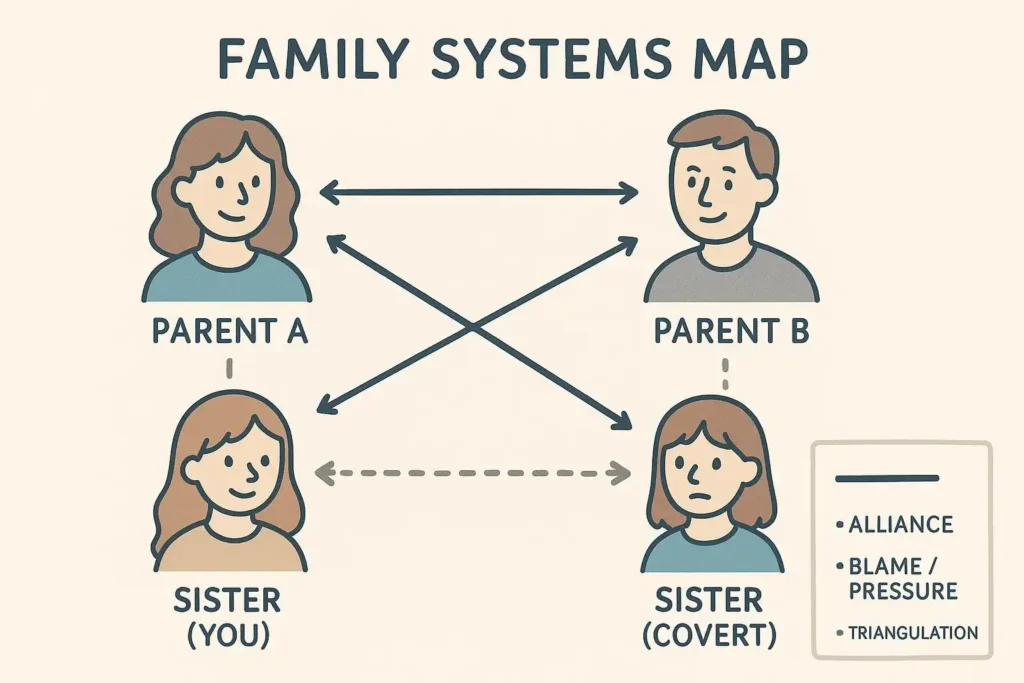
Triangulation manipulates relationships by controlling information flow. The Bowen Center, a leading family systems research institution, describes triangles as the smallest stable relationship unit, where anxiety rotates among three people to avoid direct resolution.
Your sister sets herself up as the communication gatekeeper, filtering what parents and siblings hear about you. By the time you walk into a family gathering, opinions have formed based on her version of events.
Flying Monkeys: Family as Surveillance
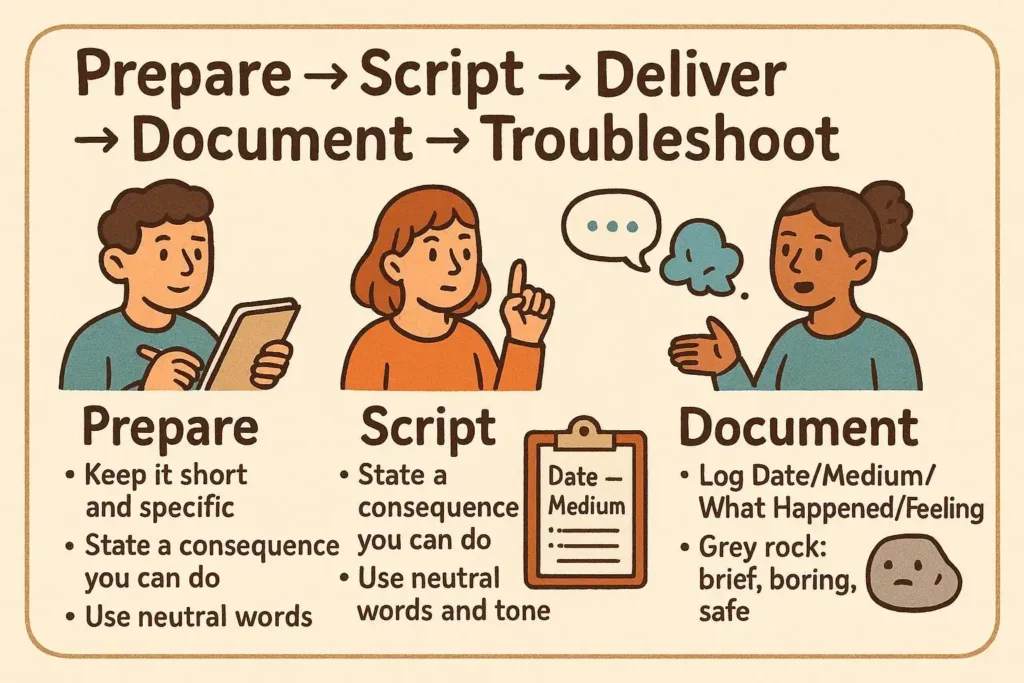
Flying monkeys come out of this dynamic. Family members serve her agenda without knowing it: reporting your activities back to her, pressuring you to apologize, monitoring whether you’re “being difficult,” and enforcing reconciliation on her terms.
Your mother calls to say your sister is “hurt” and asks why you can’t just be nicer. Your brother mentions he “heard” you’ve been distant. These aren’t neutral observations. They’re dispatches from her narrative, delivered by people who don’t realize they’ve been recruited.
You can’t vent to family because it gets back to her, reframed. You can’t set boundaries because family pressure intensifies. You become isolated within your own family, which is the point.
Smear Campaigns Disguised as Concern
She doesn’t gossip about you with malice. She expresses worry:
“I’m so concerned about her marriage.”
“I just hope she’s okay, she’s been acting so strange.”
“I try to help but she pushes me away.”
This is reputation destruction through false care. She keeps her image as the loving sister while steadily undermining how others perceive you. Family members receive a narrative where she’s reaching out and you’re rejecting her without reason. The smear campaign runs in the background because it’s wrapped in the language of love.
The Scapegoat Assignment
In families with covert narcissistic dynamics, roles get assigned. One child becomes the scapegoat: the identified problem, the container for family dysfunction. Another becomes the golden child: protected, idealized, enabled.
If your sister was set up as fragile or struggling, the family system organized around protecting her. Your job became managing her emotions, absorbing her blame, minimizing your own needs so she wouldn’t be destabilized.
This isn’t a role you chose. It’s a role the family system assigned to maintain equilibrium.
The Tactics Behind Your Confusion
Gaslighting Through “Concern”
“I’m worried about you. You seem stressed lately. Are you sure you’re remembering things correctly?”
Gaslighting from a covert narcissist sister doesn’t sound like denial. It sounds like care. She questions your memory, your perception, your emotional stability, all while appearing concerned.
This creates cognitive dissonance: she’s supposedly worried about you, but you feel worse after every conversation.
This works because it exploits your trust in her intentions. You assume she means well, so you question yourself instead of her. Over time, your self-trust erodes. You second-guess your own reality. This dynamic of covert narcissist subtle criticism makes it nearly impossible to trust your own perception.
DARVO: The Instant Flip
You address something she did. Within seconds, she’s crying. Now you’re comforting her.
How did that happen?
DARVO stands for Deny, Attack, Reverse Victim and Offender. She denies the behavior, attacks your character for bringing it up, then sets herself up as the wounded party. You entered hoping for resolution. You left apologizing.
This is why you stopped bringing things up. Every attempt at honest communication ended with you feeling guilty for having needs.
Silent Treatment as Punishment
When you set a boundary, she doesn’t argue. She disappears.
Days of cold silence. No response to messages. Pointed exclusion from family communications. Then, just when you’ve started questioning whether you were wrong, she reappears with selective kindness that resets access without acknowledging anything.
This is intermittent reinforcement. Unpredictable withdrawal followed by random warmth creates emotional dependence. You find yourself working harder to earn her approval, trying to avoid triggering another freeze-out.
Backhanded Compliments and Covert Put-Downs
“You look so much better than last time I saw you.”
“I wish I could be as relaxed as you about my appearance.”
“It’s brave that you’re wearing that.”
Covert narcissist sisters specialize in plausible deniability. The insult is embedded in what sounds like a compliment. If you react, you’re “too sensitive.” If you say nothing, the dig lands. These are classic covert narcissist belittling tactics designed to undermine you without leaving evidence.
These micro-invalidations accumulate. Each one feels small enough to dismiss. Together, they create a pattern of chronic devaluation that chips away at your self-worth so slowly you don’t notice until you’re questioning everything about yourself.
Milestone Sabotage
Your engagement announcement. Your graduation. Your promotion.
Notice a pattern? Her crisis arrives with suspicious timing.
Covert narcissist sisters struggle when attention flows to someone else. Rather than competing directly, she recenters through emergency: a health scare requiring immediate focus, a tearful revelation that overshadows your news, an argument that derails the celebration.
The pattern isn’t coincidence. It’s narcissistic supply seeking through disruption.
The Wound of Not Being Believed
The abuse was one wound. Family’s disbelief is a second, often deeper wound.
You weren’t just harmed by your sister. You were harmed again when you sought help and were told you were wrong, too sensitive, misremembering. The people who should have protected you chose her comfort over your reality. This resource on when family hurts: understanding covert narcissistic abuse explains why this secondary wound cuts so deep.
This creates a kind of pain that’s hard to name: the loneliness of being unseen by the people who are supposed to know you best.
Many survivors describe this disbelief as more damaging than the original abuse. The abuse made you doubt yourself. The disbelief confirmed it. If even your own family thinks you’re the problem, maybe you are.
You’re not. Their disbelief reflects the effectiveness of her image management and the family system’s investment in avoiding conflict. It doesn’t reflect reality.
More Articles You Might Find Helpful:
→ Why Covert Narcissists Target Empaths And Highly Sensitive People
→ Covert Narcissists & Boundary Violations: Recognizing Subtle Patterns
→ Covert Narcissists & Victim Mentality: How They Use It To Their Advantage
→ Covert Narcissist Financial Abuse: A Comprehensive Guide
→ Can Covert Narcissists Pass Psychological Evaluations? Hidden Truths
→ When Helping Hurts: The Covert Narcissist’s False Altruism
What Research Confirms About Your Experience
Survivors often wonder if they’re exaggerating or imagining patterns. Clinical research validates what you experienced.
Dr. Craig Malkin, Harvard Medical School psychologist and author of Rethinking Narcissism, distinguishes vulnerable narcissism from the grandiose type most people recognize. Vulnerable narcissists appear shy or self-deprecating but harbor hidden grandiosity and entitlement. They seek narcissistic supply through pity and rescue rather than direct admiration.
Dr. Ramani Durvasula, clinical psychologist specializing in narcissistic abuse, has documented how covert narcissists weaponize perceived victimhood. Vulnerable narcissists use their own suffering to control others, creating guilt when family members prioritize their own needs. This explains why setting boundaries with your sister triggered such intense guilt: she framed any limit as abandonment of someone wounded. This article on the covert narcissist in your family explores these family dynamics in depth.
Dr. Joseph Burgo, psychotherapist and author of The Narcissist You Know, identifies the wounded victim narcissist whose identity revolves around their suffering. This subtype seeks constant sympathy and manipulates through guilt, the dynamic that makes covert narcissist sisters so difficult to recognize. Understanding why a narcissistic abuse cycle can go unnoticed helps explain why it took you so long to see the pattern.
| Survivor Experience | What’s Happening | Why Family Misses It |
|---|---|---|
| Feeling crazy after conversations | Gaslighting through “concern” | Looks like caring from outside |
| Apologizing when she’s the aggressor | DARVO reversal completed before you realize | Family sees her tears, not the setup |
| Unable to explain abuse to family | Triangulation has pre-framed you | Your complex truth loses to her simple story |
| Dreading family events | Expecting covert attacks | Family sees you as “difficult” for not enjoying gatherings |
| Exhaustion from the relationship | Emotional labor exploitation | She appears low-maintenance to everyone else |
Conclusion
Your confusion wasn’t a character flaw. It was the intended result of covert manipulation by someone who needed you destabilized to maintain control.
What you experienced was real: the gaslighting, the DARVO reversals, the triangulation, the silent treatment, the smear campaigns wrapped in concern. And the wound of not being believed was real too.
If it took you decades to see the pattern, that’s not a failure on your part. The abuse was designed to stay hidden. It happened in unsupervised spaces, ran on absence and silence, and became your normal before you had language to question it.
Clinical research documents these patterns. Survivors around the world describe what you lived through.
You’re not difficult, oversensitive, or imagining things. Naming the pattern is the first step toward trusting yourself again.
FAQs
Why Does My Covert Narcissist Sister Only Act Cruel When We Are Alone?
She knows exactly when to perform and when she has you isolated. The warmth evaporates the moment the audience leaves because maintaining her caring public image requires you to appear unstable while she appears wounded.
How Does A Covert Narcissist Sister Use DARVO Against Me?
She denies the behavior, attacks your character for bringing it up, then positions herself as the wounded party. You enter hoping for resolution and leave apologizing for having needs.
Why Does Explaining My Sister’s Abuse Make Me Sound Crazy To Others?
Covert abuse does not photograph well. Individual incidents are small looks, tones, or carefully worded comments. Your complex pattern recognition loses to her simple story every time because she already narrated her version to family before you spoke up.
How Does Triangulation Work In Families With A Covert Narcissist Sister?
She plants seeds with phrases like “I am worried about her” and “she said the strangest thing to me.” By controlling information flow between family members, she ensures opinions form based on her version before you walk into any gathering.
What Is The Public-Private Split With A Covert Narcissist Sister?
She offers visible comfort at funerals and remembers birthdays publicly, but alone she dismisses your feelings, changes subjects to her problems, and responds to your vulnerability with criticism disguised as advice.
Why Do Flying Monkeys Report My Activities To My Covert Narcissist Sister?
Family members unknowingly serve her agenda by monitoring whether you are being difficult, pressuring you to apologize, and enforcing reconciliation on her terms. They do not realize they have been recruited into her narrative.
How Does A Covert Narcissist Sister Sabotage My Milestones?
Your engagement, graduation, or promotion triggers her crisis with suspicious timing. Health scares, tearful revelations, or family arguments recenter attention through disruption rather than direct competition.
Why Did It Take Decades To Recognize My Sister As A Covert Narcissist?
The abuse was designed to be invisible. It operated through absence, silence, and plausible deniability in spaces no adult monitored. When harmful dynamics start in early childhood and repeat thousands of times without intervention, you think this is just how sisters are.