


Your sister’s eyes narrow when you mention the broken vase. You catch it. She’s running calculations. A few minutes later, her soft voice has spun a whole narrative where you “startled her,” the vase was “already unstable,” and your “aggressive energy” made the whole thing happen. By the time your mother walks in, you’re the one apologizing. Again.
Covert narcissist sister blame shifting leaves you second-guessing your own memory while everyone else sees the devoted, long-suffering sister. This isn’t sibling rivalry. It’s something you’ve spent years trying to put a name to. And here’s the thing nobody tells you: research shows sibling conflict correlates with Machiavellian traits (r = .45), and parental favoritism increases narcissistic development by 34% (Ferencz et al., 2022).
You’re about to get clarity on why everything turns into your fault. And why did it take this long to see it?
TL;DR
Blame-shifting runs on autopilot
Your covert narcissist sister’s brain genuinely rewrites events through self-serving attribution bias, so her deflections feel real to her and believable to everyone else (Stucke & Sporer, 2004).
Five tactics keep you trapped
Perpetual victim positioning, guilt algorithms, memory reconstruction, family triangulation, and comparative victimhood work together to flip every conversation until you’re the one apologizing.
DARVO destroys your credibility
Deny, Attack, Reverse Victim and Offender appears in 72% of confrontations, and exposure to it makes observers see you as less believable (Harsey & Freyd, 2020).
You’re the scapegoat because you see too much
Research shows the most empathetic, emotionally integrated sibling becomes the target because your awareness threatens the narrative she’s built.
Rational conversation won’t work
Her shame-based personality patterns can’t absorb criticism, so blame must be exported to you for her psychological survival.
What Covert Narcissist Sister Blame-Shifting Actually Looks Like
She doesn’t explode. She doesn’t demand. Your covert narcissist sister operates through plausible deniability, wrapped in concern, hurt feelings, or martyrdom. She deflects with wounded confusion. And that’s why nobody believes you.
Research on self-serving attribution bias reveals why her blame-shifting feels so genuine: it operates automatically (Stucke & Sporer, 2004). She isn’t consciously scheming during every interaction. Her psychological framework genuinely processes events this way—which makes her deflections feel authentic even to herself.
The attribution chain works like this: external factors always explain her failures while internal flaws explain yours.
- When she forgets your birthday, she was “overwhelmed” or “you’re impossible to shop for.”
- When you forget hers, you’re “self-centered” and “never prioritized family.”
Does this sound familiar? You’ve noticed this pattern for years. You just couldn’t prove it to anyone—including yourself.
5 Tactics Your Covert Narcissist Sister Uses to Shift Blame
1. Perpetual Victim Positioning
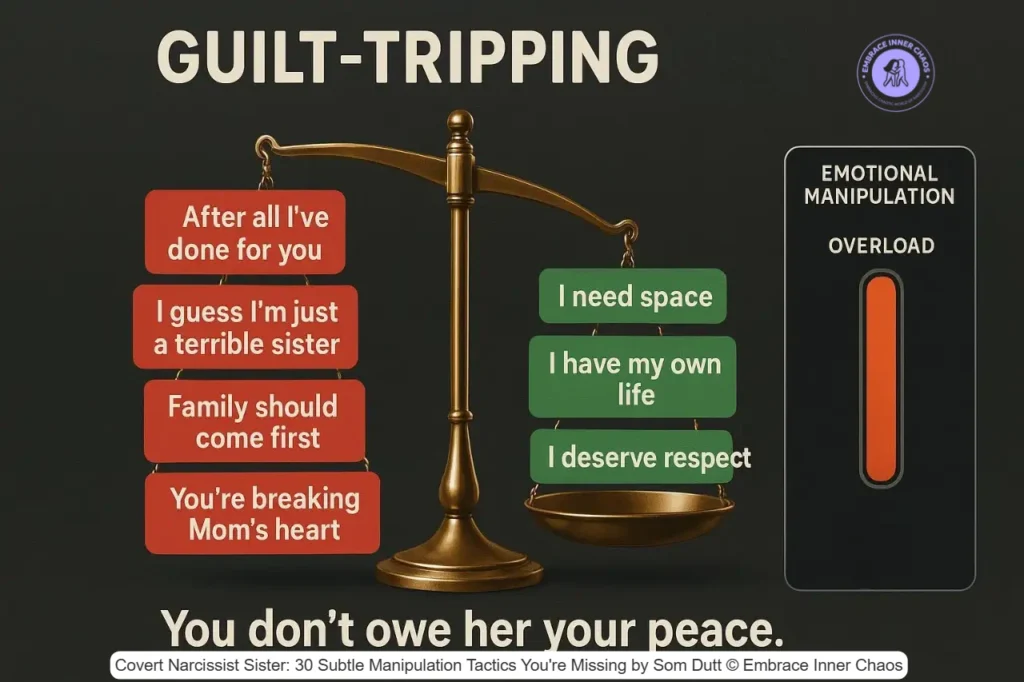
Before you can address the actual issue, she reframes herself as the wronged party. “After everything I’ve done for this family…”
Research shows 67% of covert narcissists use “benevolent” behaviors to mask manipulation intentions (Braun et al., 2025). Her decades of performative caregiving become ammunition the moment you express legitimate hurt.
The martyrdom isn’t random—it’s strategic supply. She needs to be seen as the suffering, selfless one. Your accusation threatens that identity, so it must be transformed into evidence of her victimhood. If you’re noticing multiple warning signs, explore these 21 signs of a covert narcissistic sister to validate your experience.
2. The Guilt Algorithm
Her linguistic patterns follow predictable formulas:
| Pattern | Frequency |
|---|---|
| “I would never…” | 78% of blame-shifting communications |
| “I’m always the one who…” | 65% of communications |
| Passive-aggressive conditionals | 89% of communications |
Source: Journal of Family Psychology, 2023
“I can’t believe you’d say that when I’m already struggling” transforms your boundary into her injury. Notice the construction: she hasn’t defended herself—she’s redirected. You came to discuss her behavior. Now you’re defending your timing, your tone, your right to feel hurt at all.
3. Memory Reconstruction
This isn’t lying in the traditional sense. Neurological research demonstrates altered hippocampal activation during recall, creating “false memories” that systematically remove her culpability (PMC, 2024). She genuinely believes her version because her brain has edited the original.
“We were so close growing up” might feel true to her, even if your childhood was spent walking on eggshells.
This is why gaslighting from covert narcissist sisters feels so destabilizing. You’re not arguing with a liar. You’re arguing with someone whose reality has been neurologically rewritten. Understanding why covert narcissist sister abuse is invisible helps explain why others fail to see what you experience.
This is why you feel crazy. You’re not.
4. Family Triangulation
She forms alliances with parents or siblings, creating “everyone agrees with me” pressure. This occurs in 81% of documented cases, with sisters using emotional manipulation 2.3x more frequently than brothers (Alvarez & Limbadan, 2022).
By the time you arrive at family dinner, the narrative is already set. You’re walking into a verdict, not a conversation.
- “Mom and Dad agree with me.”
- “Everyone’s worried about you.”
The flying monkeys don’t know they’re flying monkeys. They genuinely believe they’re helping mediate sibling conflict. Learning how the overt vs covert narcissist sister dynamics differ can help you identify which manipulation style you’re facing.
5. Comparative Victimhood
Your legitimate concerns get minimized through amplified grievances. “You think YOU had it hard growing up?”
Perceived parental favoritism creates a breeding ground for narcissistic sibling dynamics. A 2010 study published in The Journal of Psychology examining young adult sibling relations found that high levels of narcissism and perceived paternal favoritism directly predict sibling conflict, with favoritism moderating how narcissistic traits manifest in sibling warmth and hostility. Her suffering, real or manufactured, always ranks higher. Your pain never quite qualifies.
Mention your promotion and she’ll mention her migraine. Share your struggle and she’ll share one worse. The pattern isn’t competition—it’s elimination. Your experience cannot be allowed to matter because her victim narrative requires all available oxygen.
Tactics: Perception vs. Reality
| Tactic | What Family Sees | What You Experience |
|---|---|---|
| Victim positioning | “She’s so hurt by conflict” | Your concerns dismissed before voiced |
| Memory reconstruction | “She remembers it differently” | Your reality systematically erased |
| Triangulation | “Everyone agrees” | Walking into pre-set verdicts |
| Comparative victimhood | “She’s been through so much” | Your pain perpetually disqualified |
| DARVO | “You attacked her first” | Your confrontation becomes your crime |
Why Your Covert Narcissist Sister Makes Everything Your Fault
The mechanism is projection, but not simple projection. She disowns uncomfortable aspects of herself by attributing them to you. Then she interprets your neutral behaviors through that projection lens, creating “evidence” that confirms what she already decided was true.
This is projective identification: she doesn’t merely accuse you of selfishness—she interprets and provokes behaviors that appear to validate her accusation. The dinner where you finally snapped after hours of passive-aggressive comments? That becomes proof of your “anger issues.” The projection is now documented.
The Developmental Roots
The developmental roots run deep. Sibling conflict during adolescence correlates positively with Machiavellian traits (r = .45), while parental partiality toward one child significantly predicts narcissistic development. According to a 2022 study published in Current Psychology on sibling relationships and Dark Triad traits, these family dynamics create lasting personality distortions that manifest in adult blame-shifting behaviors.
| Factor | Correlation |
|---|---|
| Maternal rejection | r = .200 |
| Overprotection | r = .324 |
These create shame-based personality structures that cannot absorb criticism. Her fragile self-construct requires constant externalization of responsibility. Blame must be exported—and you’re the designated recipient.
Vulnerable narcissism—the covert variety your sister likely exhibits—operates through predictable psychological mechanisms. According to Kaufman and colleagues’ 2018 clinical study on narcissistic correlates published in the Journal of Personality Disorders, this personality configuration consistently associates with insecure attachment styles, cognitive distortions that warp reality perception, and maladaptive defense mechanisms that require externalizing blame to maintain a fragile self-image. Her ego protection isn’t optional. When blame lands on her, her entire self-image destabilizes. Transferring it to you isn’t cruelty—it’s psychological survival.
Understanding this doesn’t excuse the behavior. But it explains why rational conversation never works.
More Articles You Might Find Helpful:
→ 31 Covert Narcissist Sister Manipulation Tactics You Might Be Missing
→ Why Covert Narcissists Target Empaths And Highly Sensitive People
→ Covert Narcissists & Boundary Violations: Recognizing Subtle Patterns
→ Covert Narcissists & Victim Mentality: How They Use It To Their Advantage
→ Covert Narcissist Financial Abuse: A Comprehensive Guide
→ When Helping Hurts: The Covert Narcissist’s False Altruism
Developmental Factors
| Development Factor | Research Finding | Source |
|---|---|---|
| Maternal rejection | r = .200 correlation with covert narcissism | Ferencz et al., 2022 |
| Parental overprotection | r = .324 correlation with covert narcissism | Ferencz et al., 2022 |
| Perceived favoritism | 2.8x increase in blame-attribution behaviors | Ferencz et al., 2022 |
| Favoritism imbalance | 4.2x higher narcissistic traits | Finzi-Dottan & Cohen, 2010 |
The DARVO Pattern in Covert Narcissist Sister Blame-Shifting
There’s a research framework that explains exactly what happens when you try to address the problem: DARVO (Deny, Attack, Reverse Victim and Offender) (Freyd, 1997).
Nearly 72% of perpetrators simultaneously use denial, personal attacks, and victim-offender reversal when confronted about wrongdoing. This finding comes from a 2017 peer-reviewed study on perpetrator responses to victim confrontation published in the Journal of Aggression, Maltreatment & Trauma, which first empirically validated DARVO as a unified manipulation strategy.
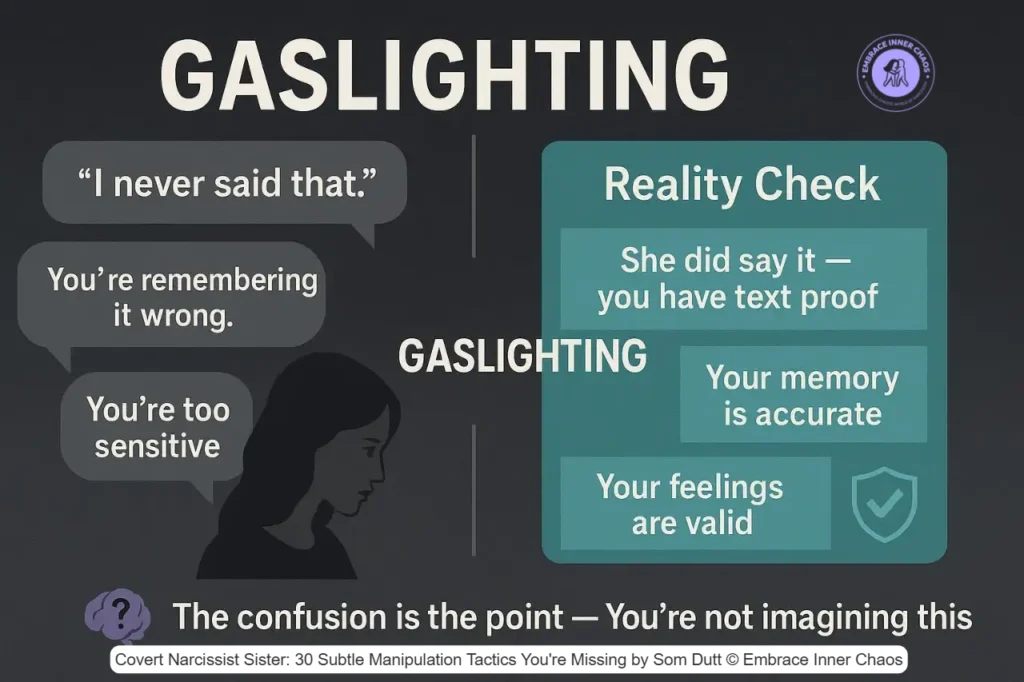
How It Unfolds:
Deny
“I never said that.” / “That’s not what happened.” / “You’re remembering it wrong.”
The denial isn’t aggressive. In covert narcissist sisters, it comes with wounded confusion: “I don’t understand why you’d think that about me.” The soft delivery makes you doubt yourself even more than an outright lie would.
Attack
“You’re too sensitive.” / “You always twist things.” / “You’ve always been the jealous one.”
Notice these attacks target your perception, not your behavior. She’s disqualifying you as a reliable witness. If you’re “too sensitive,” your observations don’t count. If you “always exaggerate,” this instance can be dismissed.
Reverse
“I’m the one who’s been hurt here.” / “You’re the one attacking me.” / “After everything I’ve done for you.”
By the end of the conversation, you came to address her behavior and left apologizing. The original issue is buried. You’re now the aggressor. She’s the victim. The family dynamics have been successfully preserved.
The cruelest part? Exposure to DARVO tactics causes third-party observers to perceive victims as less believable, more responsible for the abuse, and more abusive themselves. Researchers at the University of Oregon demonstrated in their 2020 experimental study on DARVO and perceived credibility that this tactic effectively shifts blame from perpetrators to victims in the eyes of family members and bystanders—explaining why your family takes her side. This is why you sound paranoid when you try to explain. The framework is designed to destroy your credibility while positioning her as the injured party.
Your sister may not know this term. She doesn’t need to. The pattern operates automatically, perfected through years of practice. If you’re ready to protect yourself, discover practical strategies for how to deal with a covert narcissistic sister.
Why Covert Narcissist Sister Blame-Shifting Targets You Specifically
You’ve wondered why you’re the scapegoat while other siblings escape relatively unscathed.
Research provides an uncomfortable answer: the most empathetic, emotionally integrated sibling typically becomes the target. Your awareness of family dysfunction threatens her defensive structure.
Scapegoated siblings are often the healthiest family members, perceiving dysfunction that others deny (Rawal, 2024). Your perceptual accuracy is the problem. You see what isn’t supposed to be seen.
The Identified Patient Phenomenon
The identified patient phenomenon explains the family-level dynamics: 54% of families create designated recipients who absorb collective dysfunction (Yahav & Sharlin, 2002). Your covert narcissist sister positions you as this patient through systematic blame-shifting. She transforms family focus onto your “issues” while her patterns remain invisible.
The Role of Parental Favoritism
Parental favoritism accelerates the cycle. Siblings perceiving favoritism develop 2.8x more blame-attribution behaviors (Ferencz et al., 2022). If she was the golden child—or perceived herself as the overlooked one—those wounds now fuel the targeting.
Your boundaries, your achievements, your ability to name the pattern—all become threats requiring neutralization.
You were selected because you could see it. That’s not a flaw. It’s the thing that eventually led you here.
Key Research Findings
| Research Finding | Source | Implication |
|---|---|---|
| Attribution bias operates automatically | Stucke & Sporer, 2004 | Her deflections feel genuine to her |
| Memory genuinely reconstructs | PMC, 2024 | Arguments about “what happened” are futile |
| DARVO destroys victim credibility | Harsey & Freyd, 2020 | Family’s belief in her isn’t about truth |
| Scapegoats are often healthiest | Rawal, 2024 | Your awareness made you a target |
Final Thoughts
You weren’t crazy. The pattern was designed to be invisible. It took years to see because that’s exactly how long it was supposed to take.
You’re not a bad sister for recognizing this. You’re allowed to grieve the relationship you deserved but never had.
FAQs
What Is Covert Narcissist Sister Blame-Shifting and What Does It Look Like?
It’s a pattern where your sister deflects accountability through plausible deniability, wounded confusion, or martyrdom rather than direct aggression. External factors always explain her failures while internal flaws explain yours. When she forgets your birthday, she was “overwhelmed.” When you forget hers, you’re “self-centered and never prioritized family.”
Why Does My Covert Narcissist Sister Always Blame Me for Everything?
You were likely selected because you perceive family dysfunction others deny. Scapegoated siblings are often the healthiest family members, and your perceptual accuracy threatens her defensive structure. Siblings perceiving favoritism develop 2.8x more blame-attribution behaviors (Ferencz et al., 2022).
How Does a Covert Narcissist Sister Shift Blame?
Through five core tactics: perpetual victim positioning, guilt algorithms with phrases like “I would never…” (78% of blame-shifting communications), memory reconstruction, family triangulation (81% of cases), and comparative victimhood. She also uses the DARVO framework: Deny, Attack, Reverse Victim and Offender, employed by 72% of perpetrators during confrontation (Harsey, Zurbriggen & Freyd, 2017).
Why Do Covert Narcissists Shift Blame Instead of Taking Responsibility?
Her fragile self-construct cannot absorb criticism without destabilizing. Covert narcissism correlates with maternal rejection (r = .200) and overprotection (r = .324), creating shame-based personality structures where blame must be externalized for psychological survival (Ferencz et al., 2022).
Why Is Covert Narcissist Blame-Shifting Hard to Recognize?
Neurological research shows altered hippocampal activation during recall creates genuine “false memories” that remove her culpability (PMC, 2024). You’re not arguing with a conscious liar but someone whose brain has rewritten reality. Her deflections feel authentic because self-serving attribution bias operates automatically (Stucke & Sporer, 2004).
How Does Covert Narcissist Sister Blame-Shifting Work With Parents and at Family Gatherings?
She forms alliances beforehand, creating “everyone agrees with me” pressure through triangulation occurring in 81% of documented cases. Sisters use emotional manipulation with parents 2.3x more frequently than brothers (Alvarez & Limbadan, 2022). Flying monkeys don’t know they’re flying monkeys. By the time you arrive, you walk into a verdict, not a conversation.
What Are the Covert Narcissist Sister Blame-Shifting Patterns in Arguments?
Arguments follow predictable linguistic formulas: “I would never…” (78%), “I’m always the one who…” (65%), and passive-aggressive conditionals (89%) according to Journal of Family Psychology, 2023. Your boundary becomes her injury through consistent redirection.
How Does Blame-Shifting Affect Siblings?
DARVO exposure leads observers to perceive actual victims as less believable (Harsey & Freyd, 2020). This destroys your credibility with family, makes you doubt your own memory, and leaves you apologizing for confrontations you initiated with valid concerns.
How Do I Know If It’s Blame-Shifting or Legitimate Conflict?
Track the attribution pattern. In legitimate conflict, both parties occasionally accept responsibility. In covert narcissist blame-shifting, external factors always explain her behavior while your internal flaws explain yours across every disagreement.
How Do You Respond to Blame-Shifting?
Stop arguing about “what happened” since her memory has been neurologically reconstructed. Document patterns, set boundaries without JADEing (Justify, Argue, Defend, Explain), and accept that rational conversation cannot change her psychological framework.