

Last updated on February 5th, 2026 at 06:03 am
She sobbed at your baby shower. Everyone praised her sensitivity. You saw her face when no one was looking: satisfaction. She’d made your announcement about her tears. That’s what covert narcissist sister manipulation tactics look like in action.
You’re searching because something feels off. Family gatherings leave you drained. You second-guess your own memories. Everyone else thinks she’s wonderful, but you leave every interaction feeling smaller. The gaslighting and silent treatment articles you’ve already read don’t capture what she does. Her moves are sister-specific, wrapped in “concern” and “help” that outsiders applaud.
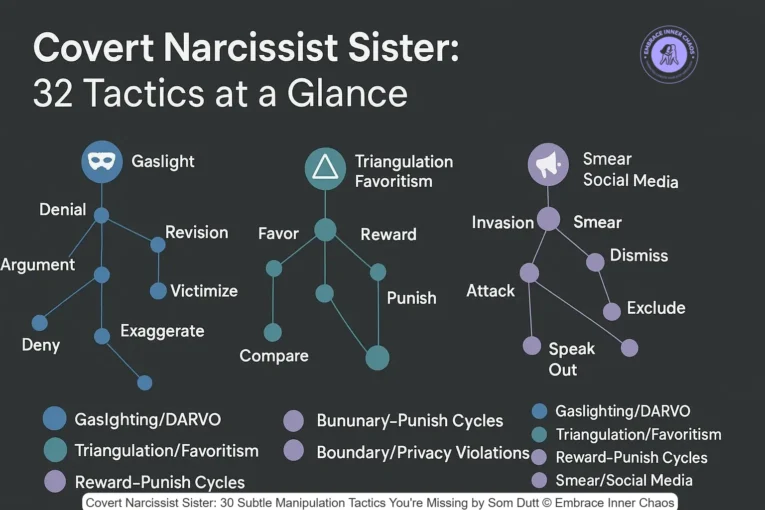
This is the list you need. 31 patterns that explain why you feel crazy when no one else sees it.
TL;DR
Invisible Abuse by Design
A covert narcissist sister manipulates through tactics no witness can verify, leaving you questioning whether anything happened at all.
The “Concerned Sister” Weapon
She spreads doubt about your mental stability by asking if you’re “okay” in ways that imply you’re not, recruiting family worry without direct accusations.
Surgical Event Sabotage
Her crises arrive within 48 hours of your engagement, promotion, or baby shower, redirecting attention through breakdowns that demand sympathy.
Flying Monkeys Work Blind
Aunts and cousins contact you thinking they’re helping, unaware she’s recruited them to pressure you back into compliance.
Years of Narrative Positioning
She maintains golden child status through visible volunteering while you handle invisible labor, framing you as “the difficult one” long before any conflict surfaces.
1. The “Concerned Sister” Performance
“I’m just worried about you.” The worry precedes an insult. She’s “concerned” about your weight, your choices, your mental health. The concern is a vehicle for criticism she couldn’t otherwise deliver.
She questions your mental health on family group texts. She asks if you’re “okay” in ways that imply you’re not. She tells relatives she’s “worried” in ways that spread the idea you’re unstable. If she’s worried and you’re denying problems, you must be the one who can’t see clear. These are textbook signs of a covert narcissistic sister that most people miss.
Sibling scenario: She comments on your social media asking if you’re “doing alright” when you’ve shown no signs of struggle. Mutual friends message you asking what’s wrong. Nothing’s wrong except that she’s establishing in public that something might be.
2. Weaponizing Shared History
She brings up the embarrassing thing you did at twelve. Every family gathering. She “remembers” things different than they happened, always in ways that make you look worse. Your childhood becomes a source of current shame.
“You’ve always been like this.” She uses the past to frame the present. Your current boundaries become further evidence of your “pattern” of being difficult.
Sibling scenario: You decline to host this year’s Thanksgiving. She reminds everyone you “always” avoid responsibility, citing incidents from high school. Your adult decision gets buried under twenty-year-old stories.
3. Competition Disguised as Support
She “helps” in ways that create problems. She “fixed” your seating chart by rearranging it. She “assisted” with your announcement by telling people early. The help accomplishes her goals while sabotaging yours. Unlike an overt vs covert narcissist sister, she hides her competition behind a mask of helpfulness.
Sibling scenario: She “helps” with your birthday party by inviting your ex without asking. The party becomes awkward. Later, she tells family she “tried so hard” to make your day special.
4. Taking Credit for Your Achievements
“We did it.” You did it. She claims it. She tells family members about “her idea” that was yours. She describes your project as a “collaboration” she led.
Sibling scenario: At your child’s birthday party, she tells guests she “basically planned everything” when you did all the work. She offered to bring napkins. She brought the wrong color.
5. Comparative Devaluation
Your accomplishments are never enough because she always knows someone who did it better, faster, younger. Your engagement ring is lovely, but her friend’s was bigger. Your promotion is nice, but she got hers “earlier in life.”
Sibling scenario: At your graduation party, she spends fifteen minutes praising a mutual friend’s “more impressive” accomplishment. Your day. Her comparison. Your joy, deflated.
6. Infantilization
She speaks to you in simplified sentences. She explains things you already know. She tells family members your opinions “for” you because you might not express them correct. You’re forty years old and she still treats you like you’re twelve.
Sibling scenario: She overrides your childcare decisions “because you don’t know better.” She answers questions directed at you. She tells your own children what you “really meant.”
7. Inheritance Manipulation
She manages your parents’ perception of her as the “responsible” one who should handle estate matters. She positions herself as the logical choice for power of attorney, executor, or primary caretaker. The positioning happens over years.
She implies that your behavior will affect your standing in the will. She claims special knowledge of what your parents “really want.” She schedules her visits to minimize overlap with yours, positioning herself as the gatekeeper between you and your parents. This is classic covert narcissist sister behavior.
Sibling scenario: She calls a family meeting about your mother’s care. She’s already discussed everything with your parents in private. The “meeting” is an announcement of decisions she made. Your input arrives too late to matter.
8. Financial Manipulation
She lends money and then treats the loan as a leash. The repayment terms shift based on your compliance. Payback is demanded when you set boundaries. Forgiveness is offered when you comply.
She pays for things you didn’t ask her to pay for, then holds the payment over you. Every financial “gift” becomes a lever in future disagreements.
Sibling scenario: She loaned you money during a rough patch. You’ve paid back most of it. But every time you disagree with her, she mentions “everything she’s done” for you with money. The loan isn’t about money. It’s about control.
9. Bribery and Gifts
The gifts are generous. They’re also a lever. She bought you the stroller, so she gets to comment on your parenting. She paid for the dinner, so you owe her your attendance at her event. The gift was never free.
Sibling scenario: She gave you an extravagant baby shower gift. Now she walks into your house without knocking, rearranges your nursery without asking, and when you object, she mentions “everything she’s done” for you.
10. Golden Child/Scapegoat Dynamics
She’s not the golden child by accident. She maintains that position through deliberate performance. She volunteers for visible tasks while you handle invisible labor. She highlights your mistakes to parents while hiding her own.
When something goes wrong in the family, the arrow points at you. Not because you caused it, but because she’s positioned you as the “difficult” one over years of narrative management. This is why covert narcissist sister abuse is invisible to outsiders.
Sibling scenario: Holiday planning revolves around her schedule, her preferences, her dietary restrictions. When you mention your needs, you’re told to “stop making everything difficult.” She’s the easy one. You’re the problem.
11. Holiday and Event Sabotage
Your engagement announcement. Your baby shower. Your promotion celebration. Her crisis arrives within 48 hours. Every time. The timing is surgical.
She doesn’t sabotage loud. She has a “breakdown.” She gets “devastating news.” She’s “not feeling well.” The sabotage comes wrapped in sympathy demands. Your birthday party becomes about comforting her. Your graduation dinner includes her tearful bathroom meltdown.
Sibling scenario: You announce your pregnancy at family dinner. Within two hours, she’s crying about her own fertility struggles she’s never mentioned before. The rest of the evening becomes about comforting her. Your announcement is a footnote.
12. Micromanipulations
Each incident seems trivial. A correction during your story. A small “clarification” that changes the meaning. A comment about your appearance delivered with a smile. On their own, nothing qualifies as abuse. Together, they add up to steady erosion.
Sibling scenario: During your wedding speech, she interjects “corrections” twice. During your promotion announcement, she mentions you “finally” did it. At your child’s birthday, she comments on the store-bought cake.
13. Mood Manipulation
She walks into a room and the temperature drops. Her sighs fill space. Her silence has texture. Before she says a word, everyone is already adjusting their behavior to prevent whatever storm is coming. Research on covert narcissists and how they manipulate shows this mood control is deliberate.
Sibling scenario: Before a family vote on where to hold the reunion, she starts brooding. Heavy sighs. Clipped answers. Nobody changes their preference out loud, but somehow the decision lands right where she wanted it.
14. Moving Goalposts
You meet her standard. The standard changes. You adjust. It changes again. The target was never meant to be hit. The point is keeping you chasing.
Sibling scenario: She asked you to bring a dish to the family dinner. You brought what she requested. She sighs and mentions she “meant” a different recipe. She never specified.
15. Feigning Ignorance or Innocence
“I had no idea that bothered you!” You’ve told her seventeen times. She widens her eyes and acts shocked every time. The performance resets the conversation. Instead of addressing the boundary violation, you’re now re-explaining why it’s a problem. Learning how to deal with a covert narcissistic sister means recognizing this tactic.
Sibling scenario: She “didn’t realize” sharing your salary with the family would bother you. She’s “so sorry” but she “didn’t know.” You told her not to, in plain words.
16. Covert Lying
She didn’t lie. She didn’t mention the relevant details. She told your parents you “might not come” to the reunion when you’d already confirmed. Technical truth: “might not” is always possible. Practical reality: she manipulated the outcome.
Sibling scenario: She told “the family” you “seemed upset about the inheritance.” You never said that. But now everyone thinks you did.
17. Word Salad
You ask a simple question. Fifteen minutes later, you’re discussing something unrelated and you’ve forgotten what you asked in the first place. She redirects, redefines terms, brings up old grievances, and circles back to starting points until you’re too exhausted to continue.
Sibling scenario: You try to confirm logistics for next weekend. Two hours later, you’ve relitigated a fight from 2019, discussed her feelings about your parenting, and somehow ended up apologizing. The logistics remain unconfirmed.
18. DARVO (Deny, Attack, Reverse Victim and Offender)
You confront her with evidence she shared your private information. First, she denies it flat. “I never told anyone.” When you present proof, she attacks. “Why are you spying on me?” The evidence is no longer the topic. Your behavior in gathering it is.
Sibling scenario: After she leaks your fertility struggles to extended family, you confront her in private. She denies it, then accuses you of “slandering” her, then cries about how “no one trusts her.”
Psychologist Freyd, J.J. (1997) first identified this deny-attack-reverse pattern in her research on betrayal trauma.
19. Minimizing
“It wasn’t that bad.” “You’re blowing this out of proportion.” “I barely even said anything.” Your pain doesn’t register because acknowledging it would require her to take responsibility. So she shrinks it. Makes it about your sensitivity rather than her behavior.
Sibling scenario: You share your engagement news. She mentions right away that her friend’s ring was bigger, then asks if you’re “sure” about the timing. Your moment of joy now feels uncertain and small.
20. Guilt-Tripping
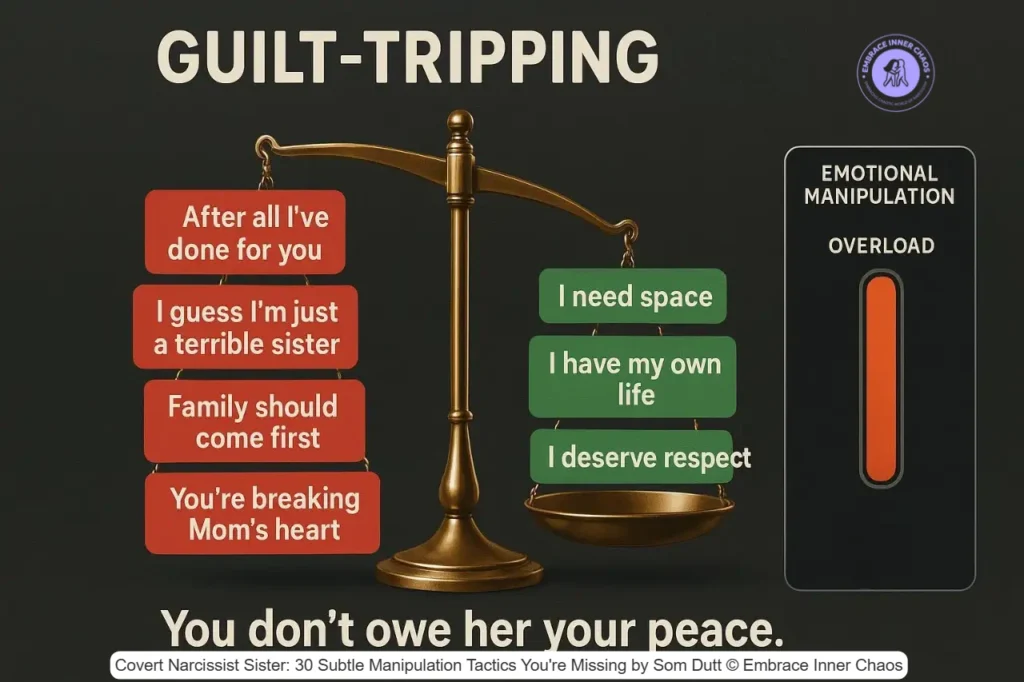
“Family comes first.” “Blood is thicker than water.” “We only have each other.” She weaponizes concepts you value for real. Your care about family becomes the lever she uses to pry open your boundaries. Understanding when family hurts through covert narcissistic abuse helps you see these patterns.
Sibling scenario: She demands you cancel your vacation to babysit during her work event. When you hesitate, she invokes family duty, her sacrifices, your moral obligation.
Research by Dr. Wei Peng, 2023 confirms guilt appeals are among the most effective manipulation tools because they exploit your desire to be a good family member.
21. Boundary Violations
You said no. She did it anyway. You’ll say no again. She’ll do it again. The boundary exists. It doesn’t matter. She tests it without pause because each violation that goes unaddressed expands her access.
Sibling scenario: You told her not to share your child’s photos online. Direct words. She posted one “by accident.” Then another that was “too cute not to share.” Now she posts often because you “got over it.”
22. Isolation
She drops hints about your friends. “I’m sure she means well, but…” She makes your partner uncomfortable at gatherings. She schedules family events when your support system can’t attend.
Sibling scenario: She schedules a “family only” brunch on the one weekend your partner can’t come. She creates a new family chat without you, then later mentions conversations you weren’t part of.
23. Smear Campaigns
She doesn’t attack your reputation loud. She erodes it in whispered concerns. “I’m worried about her.” “She hasn’t been herself lately.” By the time you notice people treating you different, she’s already shaped their perception.
Sibling scenario: Before Thanksgiving, she calls your grandparents and aunts with vague concerns about your “mental state.” When you arrive, everyone’s handling you with care. Your own family now views you through her lens.
24. Flying Monkeys
She doesn’t pressure you direct. She sends emissaries. Your aunt calls “just to check in” but somehow knows details about your last argument. Your cousin texts to say you should “give her another chance.” These people think they’re helping. They don’t know they’ve been recruited.
Sibling scenario: A cousin calls to ask your “side” of a recent conflict. You share honest, believing it’s confidential. Within hours, she’s texted you quotes from that conversation, twisted a bit.
More Articles You Might Find Helpful:
→ Why Covert Narcissists Target Empaths And Highly Sensitive People
→ Covert Narcissists & Boundary Violations: Recognizing Subtle Patterns
→ Covert Narcissists & Victim Mentality: How They Use It To Their Advantage
→ Covert Narcissist Financial Abuse: A Comprehensive Guide
→ Can Covert Narcissists Pass Psychological Evaluations? Hidden Truths
→ When Helping Hurts: The Covert Narcissist’s False Altruism
25. Triangulation
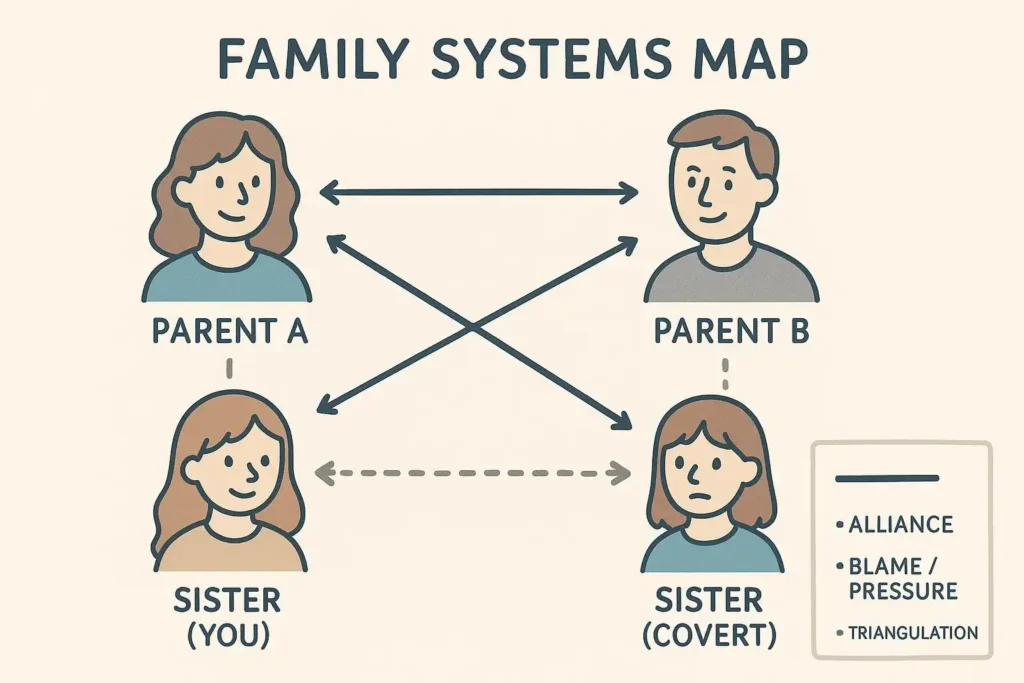
She tells you what your brother “really thinks” about your parenting. She tells your brother what you “said” about his wife. Neither conversation happened the way she reports it, but now you’re circling each other with suspicion while she plays peacemaker.
Sibling scenario: She asks your cousins to “weigh in” on your decision to limit holiday visits. She’s framed the question to make you sound unreasonable. Now extended family members are texting you about “keeping the family together.”
26. Projection
She gossips about you all the time, then warns family that you’re “such a gossip.” She competes with everything you do, then tells people you’re “so competitive.” She’s controlling, but you’re the one with “control issues.”
Sibling scenario: She starts a feud between you and your brother with selective storytelling. When the relationship fractures, she tells everyone you’re “drama” and she’s “staying out of it.” She caused it. You wear it.
27. Blame-Shifting
“If you hadn’t used that tone, I wouldn’t have yelled.” “You made me lie because you overreact to everything.” Her behavior is always your fault. Your reaction caused her action. Your boundaries triggered her violation.
Sibling scenario: She ruins your anniversary dinner with a dramatic scene. Later, she tells family it happened because your “tone” at lunch “forced her hand.” You weren’t even at lunch.
28. Passive Aggression
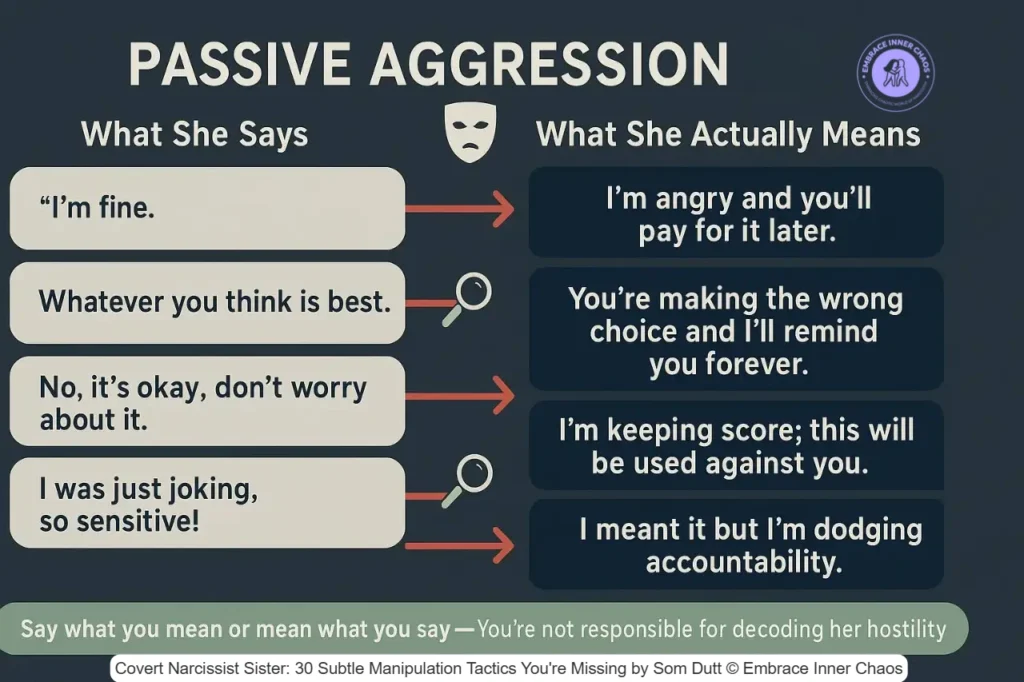
“You look so much better than last time.” “That’s brave of you to wear that.” She delivers insults wrapped in compliments so you can’t call them out without looking paranoid. If you react, she widens her eyes. “I was being nice?”
She “forgot” to tell you the party time changed. She “didn’t see” your text. These aren’t accidents. They’re punishments delivered through omission.
Sibling scenario: She “forgets” to mention that family arrived two hours early for the reunion. You show up “late” to an event you thought you were on time for. Everyone’s already eating. She apologizes with a smile while family members give you disappointed looks.
Studies by Young-Ok Lim, 2022, on how passive aggression operates as a personality trait confirm these behaviors are deliberate, not accidental.
29. Playing the Victim
The moment you address her behavior, she flips the script. You came to discuss how she hurt you. Within three sentences, you’re apologizing. Her tears appear on cue. “I can’t believe you think I would do that.” “You’re always attacking me.”
Sibling scenario: You ask her not to share your child’s photos online. She posts anyway. When you confront her, she bursts into tears and calls your parents to say you’re “punishing her for loving her niece.”
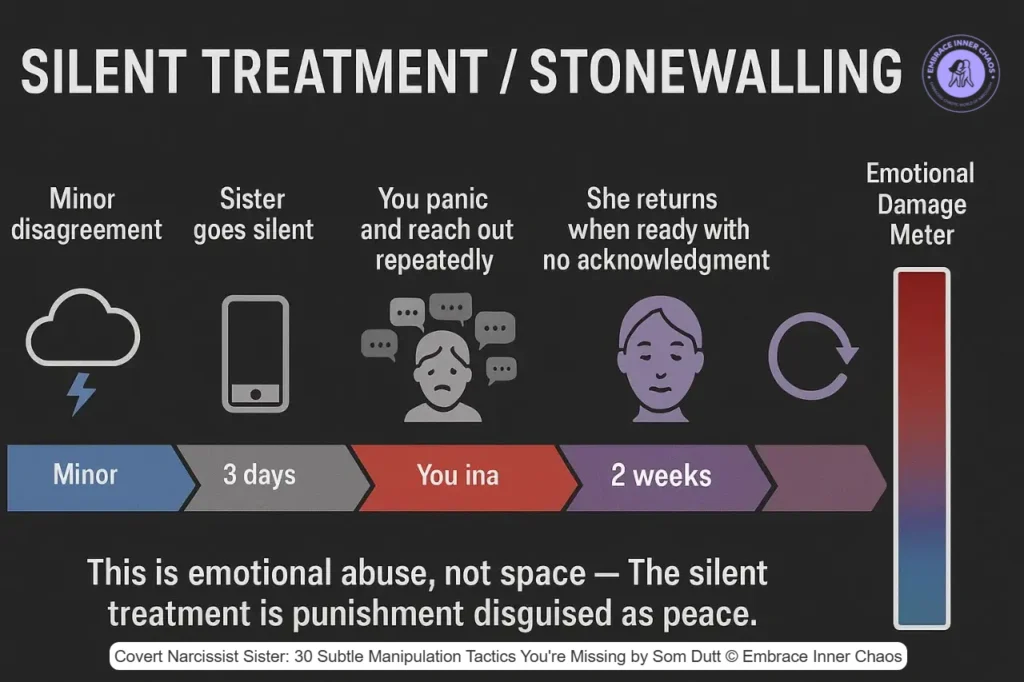
30. Silent Treatment
She stops talking to you. No explanation. No response to texts. At family events, she looks through you like glass. This isn’t a cooling-off period. It’s punishment.
Sibling scenario: After you declined to host Christmas, she went silent for three weeks. Then she showed up at your mother’s birthday acting like nothing happened. When you mentioned the silence, she looked confused. “I was just busy.”
Research by Dr. Karena Leo, 2022 on demand-withdraw dynamics in close relationships shows silence functions as a control mechanism, not a cooling-off period.
31. Gaslighting
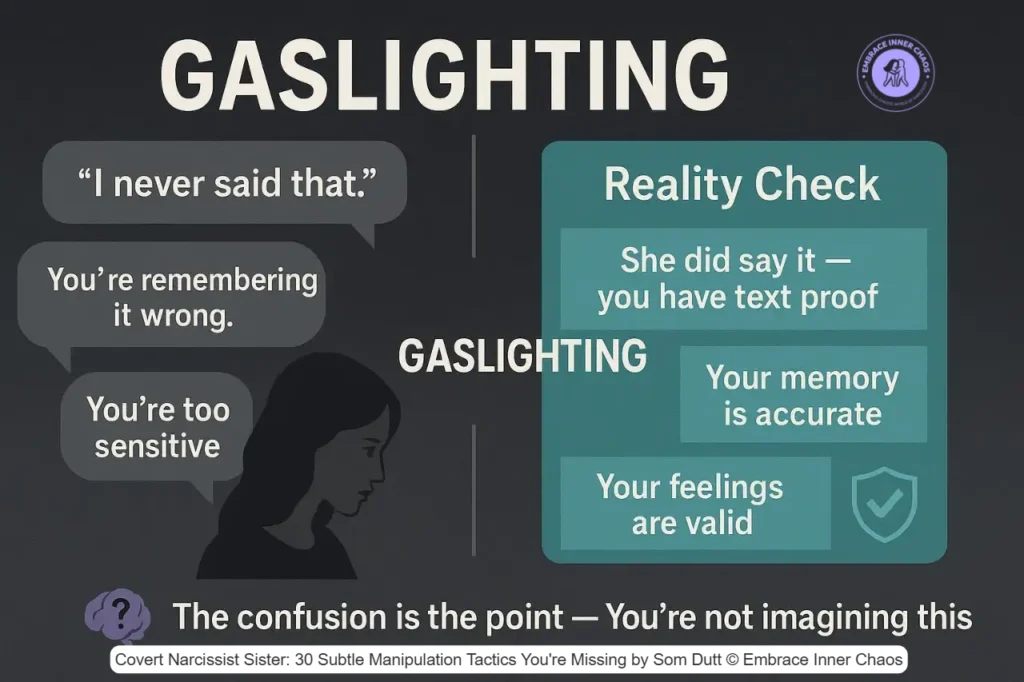
She rewrites history mid-conversation. You remember the argument clear. You remember her words, the exact ones. But when you bring it up, she looks at you like you’ve lost your mind. “I never said that.” “That’s not what happened.”
She plants seeds about your sanity. “Have you been sleeping okay?” after you confront her. “I’m worried about you” when you set a boundary. She tells family members she’s “concerned” about your mental health, playing the caring sister while framing you as unstable.
Sibling scenario: After she criticized your parenting in a group text, she later insists it “never happened,” with screenshots sitting right there. When you show the screenshots, she claims you “took it out of context” or “edited them.”
Recent psychological frameworks by Dr. Willis Klein, 2025 explain how gaslighting erodes a victim’s trust in their own perception.
Conclusion
These thirty-one tactics share one thing: they’re designed to be invisible. She doesn’t abuse in ways witnesses can verify. She erodes in ways that make you question whether anything happened at all.
Now you have language for what you experienced. The confusion wasn’t a character flaw. It was engineered. The exhaustion wasn’t weakness. It was the expected result of years of manipulation by someone who was supposed to protect you.
What you lived through has names now.
FAQs
How Do I Recognize If My Sister Is A Covert Narcissist?
Covert narcissist sisters weaponize subtle tactics like gaslighting to distort your reality, triangulation to pit family members against each other, and chronic victim-playing while maintaining a helpful facade to outsiders. If five or more manipulation patterns recur and escalate when you attempt boundaries, consider trauma-informed therapy and start documenting interactions.
What Distinguishes Covert Narcissist Sisters From Overt Narcissists?
Unlike overt narcissists who demand center stage openly, covert sisters operate through passive-aggression, strategic silent treatment, and victim narratives while appearing supportive in public settings. They control family dynamics without obvious aggression, making their manipulation harder to identify and address.
How Do Covert Narcissist Sisters Manipulate Family Dynamics?
They spread half-truths between siblings to create division, use emotional withholding as punishment for challenging their control, and rewrite family history to position themselves as perpetual victims. They employ DARVO (Deny, Attack, Reverse Victim/Offender) in confrontations, making you appear unstable while avoiding accountability.
Why Do Covert Narcissist Sisters Sabotage Celebrations And Milestones?
They manufacture drama during holidays, weddings, or sibling achievements to redirect family attention back to their manufactured crises. This ensures focus remains on their emotional needs rather than celebrating others’ success, reinforcing their centrality in family dynamics.
What Psychological Impact Do Covert Narcissist Sisters Have On Siblings?
Siblings develop chronic self-doubt, persistent guilt patterns, avoidant attachment styles, and automatic achievement downplaying. You feel perpetually responsible for maintaining family harmony while walking on eggshells, creating long-term trauma responses that require professional intervention.
How Do Covert Narcissist Sisters Use Financial Control?
They manipulate inheritance distributions through parent favoritism campaigns, create emotional debt through strategic gifts or loans with strings attached, and position themselves as financial victims to extract resources. They leverage family obligations to maintain access to information and financial leverage.
How Do Covert Narcissist Sisters Recruit Flying Monkeys?
They manipulate parents and mutual friends by presenting selective truths, positioning themselves as the reasonable party “trying to help” the problematic sibling, and playing victim to gain allies. These flying monkeys unknowingly enforce the narcissist’s agenda through guilt-tripping and pressure tactics.
What Boundary Violations Are Common With Covert Narcissist Sisters?
They test limits through gradual privacy invasion (reading texts, demanding passwords), emotional dumping without consent, time manipulation disguised as emergencies, and weaponizing family obligations to maintain surveillance access. Boundaries are treated as personal attacks rather than healthy limits.
How Do I Set Boundaries Without Escalating Conflict?
Use logistics-only language with short sentences and clear options: “I’m not available Sunday. You can email details; I’ll reply by Tuesday.” Avoid JADE (justify, argue, defend, explain) as explanations become ammunition. Document escalation patterns if pressure intensifies after boundary attempts.
What Should I Do When Parents Take Her Side?
Step out of triangulation by stating: “If you have feedback, tell me directly. I won’t discuss this in group threads.” Communicate your position once, then disengage from circular debates. Keep written records if character smears begin spreading through family networks.
When Should I Document Interactions Or Seek Professional Help?
Document immediately if you experience privacy breaches, defamation campaigns, harassment patterns, concerns about child safety, or financial control attempts. Seek legal counsel for stalking behavior, custody disputes, or reputation smears; pursue clinical support for trauma symptoms, panic attacks, or depression stemming from the relationship.
Can Low Contact Actually Work With A Covert Narcissist Sister?
Low contact succeeds when paired with firm structures: email-only communication, defined response windows (48-72 hours), blocked escalation paths (no surprise visits), and enforced consequences like ending calls that cross established lines. If safety concerns persist despite boundaries, consult professionals about transitioning to no contact.