


Last updated on February 8th, 2026 at 09:01 am
Your sister collapses into tears at family gatherings, claiming victimization as you sit there silent about her private cruelty. None of it is coincidental. 69% of narcissists display both grandiose and vulnerable traits, weaponizing perceived weakness to maintain control.
If you’ve ever searched for “covert narcissist sister playing victim,” you already sense something deeper is happening — and recognizing these patterns requires examining behavioral signs grounded in clinical evidence. You’re not imagining this, and you’re not alone in it.
TL;DR
Vulnerable Narcissism Drives Genuine Victimhood
Your covert narcissist sister playing victim isn’t performing. Cortisol studies confirm vulnerable narcissists flood with stress hormones at perceived slights. Victimhood is baked into the personality.
Image Management Powers the Split
Public halo, private coercion. She praises you before relatives, devalues you after they leave. Kids detect this before adults.
DARVO Plus Triangulation Isolate You
She denies, attacks, reverses victim and offender. Observers side with her unless educated. She routes family updates through her hub, editing your words before they land.
Procedures Beat Debates
Group texts, written updates, time-boxed contact dismantle triangulation faster than any confrontation.
Your Body’s Alarms Are Data
Stomach knots, chest tightness, GI distress around her are autonomic responses. Use them to set boundaries and plan exits.
Your sister collapses into tears at family gatherings, claiming victimization as you sit there silent about her private cruelty. None of it is coincidental. 69% of narcissists display both grandiose and vulnerable traits, weaponizing perceived weakness to maintain control. Recognizing a covert narcissist sister playing victim requires examining behavioral signs grounded in clinical evidence.
You’re not imagining this, and you’re not alone in it.
| What the Research Found | Source |
|---|---|
| 43.9% of relatives reported abusive behaviors from narcissistic family members | Day, Townsend & Grenyer (2022), n=436 |
| 78% of narcissistic abuse survivors experienced symptoms consistent with C-PTSD | Singh (2024) |
| 15.4% of survivors in research samples are family members, not romantic partners | Singh (2024) |
| Depression scores 8.40 vs. population norm of 5.39 among relatives | Day, Townsend & Grenyer (2022) |
| Anxiety scores 2.26 vs. population norm of 1.48 among relatives | Day, Townsend & Grenyer (2022) |
Sibling abuse from a covert narcissist sister stays invisible because nobody’s studying it the way they study romantic relationships.
Recognizing the Vulnerable Narcissism Profile
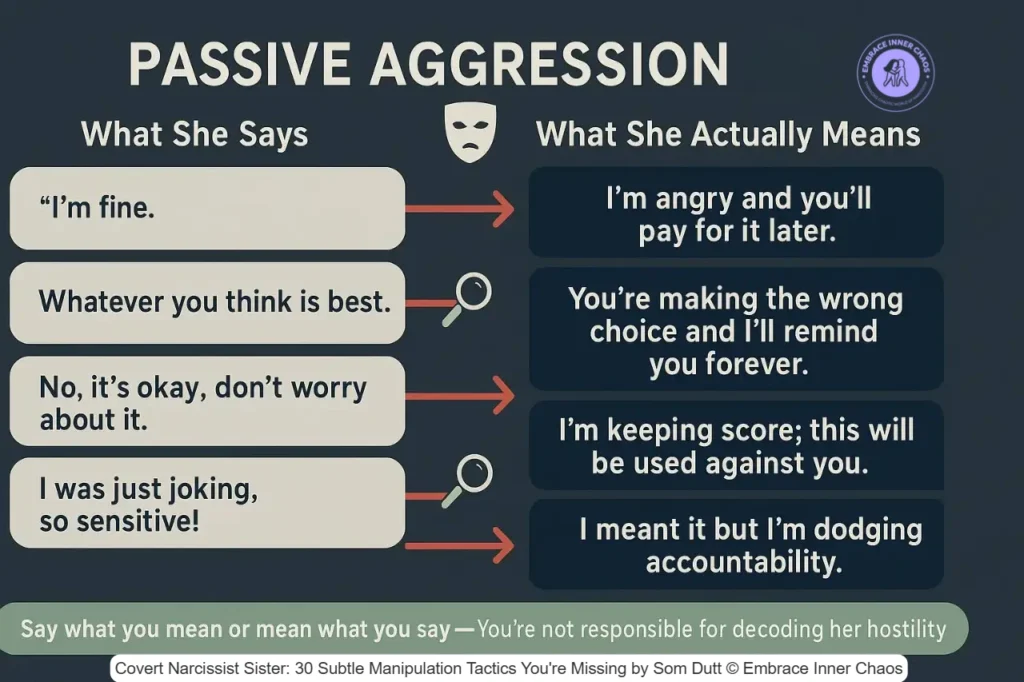
Unlike grandiose narcissism’s overt superiority, covert narcissism operates through hypersensitivity, shame identification, and victimhood narratives. Your sister constructs a “false self,” appearing confident when people are watching, then displaying insecurity when you’re alone together. This splitting creates an illusion of persecution. She frames routine disagreements as attacks. Offer her feedback and she fires back with volatile responses. Relatives report “walking on eggshells” because perceived criticism provokes disproportionate emotional withdrawal or rage. These are textbook signs of a covert narcissistic sister.
Contingent Self-Esteem and Its Roots
Contingent self-esteem drives all of it. Vulnerable narcissists demand constant compliments and reassurance, yet dismiss genuine praise as not enough. When you fail to validate her unrealistic self-image, she reads your silence as rejection, justifying retaliation.
It goes back to childhood attachment trauma. Emotionally invalidating environments create narcissistic patterns where individuals never merge their grandiose and insecure aspects. Traumatic empathic failures, where caregivers fail to mirror emotional needs, do most of the damage. If your parents were strict, demanding better performance without praise, your sister developed self-worth contingent on achievement. That’s where the need for constant validation and those out-of-proportion reactions to criticism come from.
How Parental Favoritism Feeds It
Parental favoritism intensifies these traits. Studies show parental partiality toward siblings correlates with narcissism development, according to Ferencz et al. (2023) in Current Psychology. Unfavored children compensate through narcissistic functioning. If your sister received preferential treatment, her entitlement grew out of developmental reinforcement; if disfavored, she weaponizes victim status to reclaim parental attention. Unfavored children develop narcissism as compensation for perceived rejection. Favored children develop entitlement from preferential treatment. Both paths lead to victim-playing behaviors: unfavored siblings use victimhood to reclaim attention; favored siblings use it to keep their privileged position.
The Mask Drop in Real Time
You can watch the mask drop happen. She gushes over your cooking in front of relatives. Three minutes after they leave, she whispers, “Don’t bring that again. It embarrassed me.” Your child watches both scenes. They stop asking to show Aunt their drawings. Kids pick up on this before adults do. Selective trust research shows children track accuracy over “niceness,” learning to distrust people whose words never match their private behavior. Your eight-year-old figured it out. It took you twenty years.
Why She Believes Her Own Victimhood: Research Evidence
But why does she actually seem to believe she’s the victim? A 2023 study published in Frontiers in Psychology (n=47) tested cortisol reactivity under psychosocial stress. Vulnerable narcissists showed a significant cortisol increase (M=0.27, SD=0.24) compared to grandiose narcissists who showed a blunted cortisol response (M=-0.03, SD=0.10, p=0.015). They also reported increased anxiety, anger, and shame. Her body is flooding with stress hormones at perceived slights that wouldn’t register for most people. She’s not faking distress. She’s feeling it. None of that excuses the abuse. But it does explain why the victim act is so convincing.
Bedard et al. (2024) studied 400 Canadian adults and found Tendency for Interpersonal Victimhood (TIV) was tied straight to vulnerable narcissism. Both traits were linked to neuroticism. Victim signaling was predicted by both grandiose and vulnerable narcissism, but through separate mechanisms. Your covert narcissist sister playing victim isn’t choosing a strategy from a menu. Victimhood IS baked into the personality. It’s how she processes the world. This is covert narcissist victim mentality at its core.
Green and Charles (2019) documented in qualitative interviews that victims reported again and again how narcissists “started playing the victim” after narcissistic injury. McCullough et al. (2003) found people high in narcissism perceive themselves as victims of interpersonal transgressions more often than those without narcissistic traits. She doesn’t just play the victim. In her version of events, she IS the victim.
31% of relatives in Day et al.’s study reported experiencing idealization-devaluation cycling from their narcissistic family member. Narcissism runs in families through genetics and environmental factors, with environment often contributing more than genetics. If your parents exhibited narcissistic traits, your sister picked up these patterns through modeling. Narcissistic parents use favoritism and scapegoating tactics that pit children against each other, breeding jealousy rather than cooperation.
How She Manipulates Public Perception
Victim-playing narcissists fabricate or twist events so they appear as hero or victim, never antagonist. Your sister rehearses narratives that omit her aggression and blow up your defensive reactions. At family dinners, she references your “angry outbursts,” but she leaves out the hours of provocation preceding them. Selective memory like this exploits witnesses’ incomplete information. She ends up cast as the wronged party.
Concern-Trolling Phrases to Listen For
Listen for these phrases. They’re concern-trolling dressed as sisterly love:
“Between us, I’m worried about her.”
“She seems off lately, don’t you think?”
“I hate to say this, but someone needs to.”
Each one plants doubt about your stability and frames her as the caring one. It’s covert character assassination with plausible deniability baked in. If you confront it, she says, “I was just concerned.” And everyone believes her.
Strategic Vulnerability
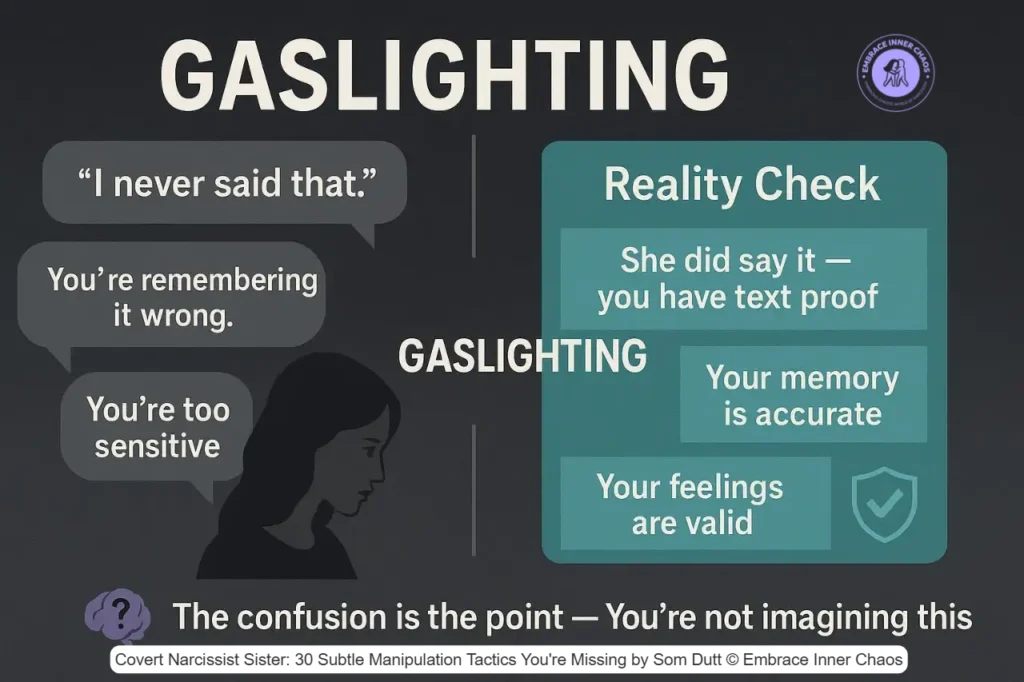
Then comes strategic vulnerability. When confronted, vulnerable narcissists “crumble into a sobbing mess, wondering why it’s always their fault.” Focus shifts from their behavior to their emotional distress. Family members see her tears and pressure you to apologize for “upsetting” her. Her victimhood gets reinforced. Your legitimate grievances? Dismissed. She may also invoke moral frameworks to cast her demands as righteous requirements, so that resisting her control makes you the antagonist opposing virtuous behavior.
Private Terror: What Happens Behind Closed Doors
That private-public split? Not accidental. It shows deliberate manipulation. Covert narcissists exert complete control over family tasks, where anything not meeting their standards is “wrong,” accompanied by devaluation. She micromanages your contributions, then complains in front of everyone about doing everything alone. When you attempt tasks on your own, she criticizes execution but refuses to delegate. She builds impossible standards that justify her martyrdom narrative.
The Communications Hub
Over years, she turns herself into the family’s communications hub. “Loop me in.” “I’ll pass that along.” “Text me first and I’ll let Mom know.” Soon every update routes through her. This is one of the most damaging covert narcissist boundary violations in families. She versions your words: “She’s overwhelmed” becomes “She’s struggling” becomes “She’s unstable.” By the time your message reaches anyone, it’s been rewritten. You fix this structurally, not emotionally.
Script: “Please include me on any updates about Mom directly.” Default to group texts. Decline one-on-one relays. For more actionable responses, see how to deal with a covert narcissistic sister.
Milestone Sabotage
Watch for the timing. A covert narcissist sister playing victim will manufacture a health crisis, a breakdown, or an emergency that lands days before your wedding, your graduation, your baby shower, your promotion announcement. The function is clear: re-center attention, erase your joy, paint you as callous if you proceed with your milestone. It’s not coincidence when it happens once. It’s a pattern when it happens every time something good is about to be yours.
Script: “I’m sorry you’re unwell. I can’t cancel this. I’ll check in by text tomorrow.”
Emotional Withdrawal as Weapon
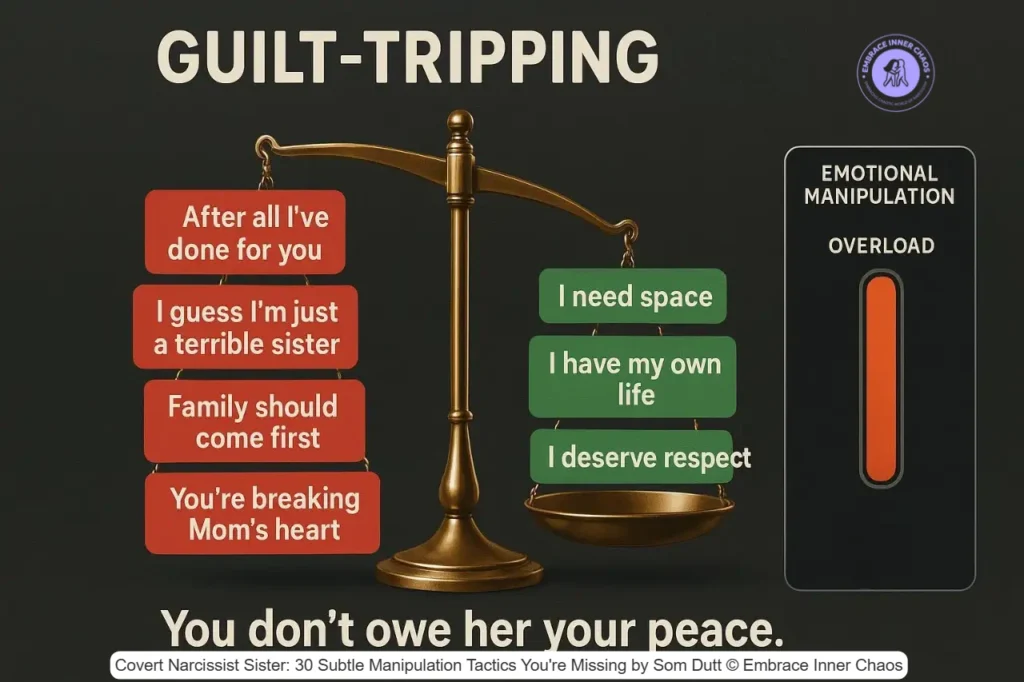
Emotional withdrawal weaponizes the silent treatment. Vulnerable narcissists pull away physically or psychically, driven by shame and inadequacy. After terrorizing you behind closed doors, she vanishes. You’re the one who has to reach out first, initiate reconciliation, play peacemaker. She gets to stay the wounded party. And the cycle keeps going. You become the aggressor seeking forgiveness for reacting to her abuse.
Higher narcissism levels predict less closeness and higher conflict in sibling relationships. Your sister likely exhibits “domineering” and “vindictive” interpersonal problems. She controls conversations, dismisses your experiences, retaliates against perceived slights. These behaviors stay invisible to outsiders who only witness her public performance, which is why covert narcissist sister abuse is so hard to spot.
Family Scapegoating: How Your Covert Narcissist Sister Playing Victim Isolates You
Scapegoating grows out of pathological projective identification, where the family’s collective problems are projected onto one individual. Your sister, often the “golden child,” adopts parental scapegoating narratives. She labels you “crazy,” “liar,” or “emotionally unstable” without factual basis. She perpetuates this even after parental death, and recruits other family members through family mobbing, gang-up bullying built to humiliate the target.
Narcissistic family members use triangulation. They communicate through other siblings to create confusion and mistrust. Your sister tells other relatives you “never cared” about parents, cites your absence at events, and leaves out that she made your presence unbearable. Indirect manipulation like this prevents direct confrontation and eats away at family relationships.
DARVO: The Perception Flip
DARVO (Deny, Attack, and Reverse Victim and Offender) seals the isolation. She denies abusive behavior, attacks you for reacting, then claims victimization from your “instability.” Example: after stealing inheritance, she states “Dad never loved you anyway, and you weren’t around to help, so I deserve more assets.” Family members see her distress, not her theft, and validate her victimhood.
Data backs this up. Controlled vignette experiments show that observers exposed to DARVO perceive the real target as less credible and assign more blame to them. Brief education about the tactic reduces the effect, but most families never get that education. Your relatives aren’t siding with her because they don’t love you. They’re siding with her because DARVO is built to flip perception, and it works.
How the Abuse Cycle Locks In
Here the abuse cycle locks in. Your sister perceives rejection, disapproval, embarrassment, or abandonment, real or invented. Your success, independence, or refusal to comply triggers disproportionate threat responses. She abuses you: verbal belittling mixed with projection, lies about events and claims you initiated them. It goes on until exhaustion forces defensive reactions.
Then comes the flip: your defensive behavior becomes evidence that she’s being abused. She references past defensive reactions as proof you initiated the abuse. Your remorse and guilt validate her warped perception. You rush to rescue her through placation and acceptance of unnecessary responsibility. Your capitulation justifies her superiority, feeds the narcissistic ego, makes it stronger. That high lasts until the next perceived threat, and the cycle restarts.
The Hoover
Then the hoover shows up. Weeks or months of silent treatment, then sudden nostalgia texts, unexpected gifts, a crisis that “only you” can help with, or a third-party reaching out on her behalf: “She misses you so much.” It’s not about reconciliation. It’s about re-opening access and restoring the supply line.
Script: “I’m available for logistics by text only. Not open to other topics right now.”
More Articles You Might Find Helpful:
→ 31 Covert Narcissist Sister Manipulation Tactics You Might Be Missing
→ Why Covert Narcissists Target Empaths And Highly Sensitive People
→ Covert Narcissists & Boundary Violations: Recognizing Subtle Patterns
→ Covert Narcissists & Victim Mentality: How They Use It To Their Advantage
→ Covert Narcissist Financial Abuse: A Comprehensive Guide
→ When Helping Hurts: The Covert Narcissist’s False Altruism
Recognition Is Not Reconciliation
Your body knows what’s happening before your mind accepts it. Stomach knots when her name appears on your phone. Chest tightness driving to family events. GI distress the week before holidays. Trembling hands during or after her calls. These aren’t weakness. They’re data. Chronic relational stress dysregulates autonomic balance, drives hypervigilance, and produces somatic symptom clusters. Track your symptoms around interactions with her. That pattern will tell you what you already know.
Knowing these patterns doesn’t obligate relationship maintenance. Narcissistic family members create conditions leading to estrangement through favoritism, triangulation, and emotional manipulation. Your awareness of her covert narcissism and victim-playing validates experiences once dismissed as your sensitivity or imagination. Abandoning these patterns would require her to confront shame, insecurity, and her role in relationship destruction. That’s an unbearable prospect for someone whose identity depends on external validation and superiority narratives. You’re not overreacting. Your body knew before your mind did. You’re responding to documented abuse patterns that destroy sibling bonds across families worldwide.
FAQs
How Does A Covert Narcissist Sister Play Victim Using DARVO On Parents?
She denies her behavior, attacks your reaction, then reverses roles so your parents see her as the wounded one. Send a brief note explaining DARVO after the conflict, not during it, because research shows even short education reduces the tactic’s effect on observers.
Why Does My Covert Narcissist Sister Fake Illnesses Before My Milestones?
Mysterious health crises before your wedding, graduation, or promotion hijack attention and force you to choose between celebrating or looking heartless. The pattern repeats because it works: family members rally around her while your milestone quietly disappears.
What Triggers A Covert Narcissist Sister’s Mask To Slip?
Your success without her involvement, public praise directed at you, or boundaries that cut her access to family narratives. Each one threatens the control and superiority her false self depends on.
How Does A Covert Narcissist Sister Manipulate Inheritance And Elder Caregiving?
She positions herself as primary caretaker to restrict your access to aging parents, control medical information, and influence financial decisions. Counter with scheduled group updates, shared calendars, and speakerphone on medical calls so no single person filters what you hear.
Why Do Families Believe A Covert Narcissist Sister Playing Victim Over The Scapegoat?
Her public performance aligns with the family’s denial system. Believing her means relatives avoid confronting generational dysfunction, so you become the “difficult” one for telling the truth.
How Do I Document A Covert Narcissist Sister Playing Victim?
Save texts showing concern-trolling patterns, note dates her “emergencies” coincide with your milestones, and collect witness statements from anyone who has seen the mask drop. Written records shift the evidence from your word against hers to a visible, timestamped pattern.
Should I Go No Contact With My Covert Narcissist Sister?
Consider it if your safety, health, or children’s wellbeing are at risk and lower-intensity boundaries have failed. Make that decision alongside a trauma-informed clinician and, where relevant, legal counsel.