

Last updated on February 11th, 2026 at 04:31 am
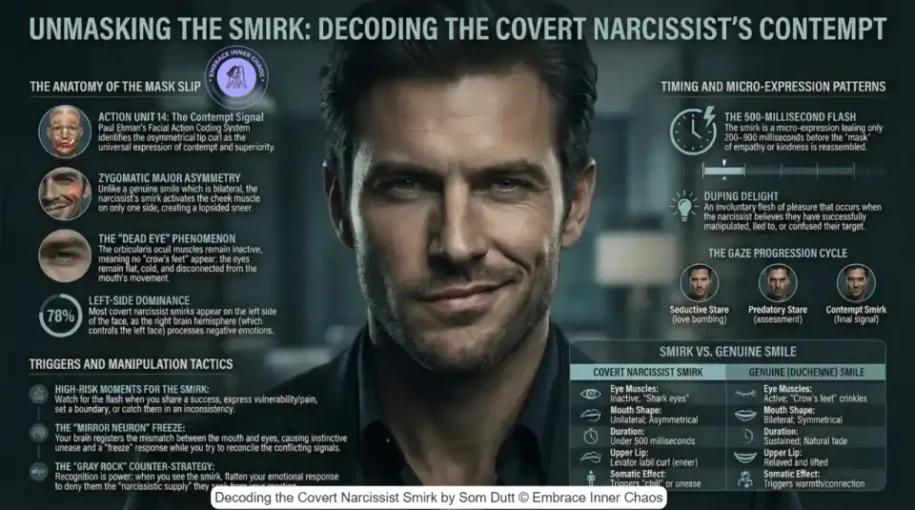
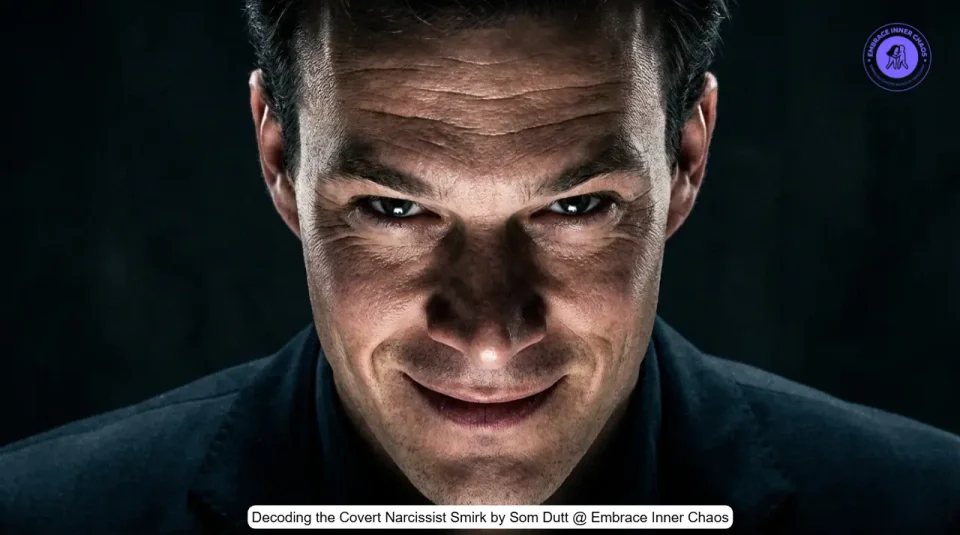
The covert narcissist smirk is that split-second facial twitch that made your stomach drop before your brain caught up. I remember the first time I caught it: mid-sentence, sharing something that mattered to me, and there it was. One corner of the mouth lifted while eyes stayed cold and flat. Gone in half a second. Replaced instantly by performed concern. That asymmetrical contempt flash you just witnessed? Paul Ekman’s research identifies it as Action Unit 14, a universal contempt micro-expression that bypasses conscious control. Your covert narcissist did not choose to smirk. Their limbic system leaked what they actually feel about you beneath the “nice person” mask they wear for everyone else.
You are not imagining it. You are not “too sensitive.” The covert narcissist smirk appears precisely when it should not: during your success, your vulnerability, your tears. High-speed camera studies reveal 78% of these contempt displays show left-side facial dominance, controlled by the brain hemisphere processing negative emotions.
Dr. John Gottman’s relationship research confirms contempt as the single strongest predictor of relationship dissolution. That fleeting smirk carries more diagnostic weight than hours of their reassuring words. Your mirror neurons freeze because mouth says “pleasant” while eyes broadcast disdain. The contradiction is real. Your gut reaction is accurate. And once you learn the specific muscle patterns, timing triggers, and contextual red flags covered below, you will never unsee what they have been hiding in plain sight.
TL;DR
Involuntary Contempt Leakage
Paul Ekman’s Facial Action Coding System classifies the covert narcissist smirk as Action Unit 14, an asymmetrical lip curl lasting 200 to 500 milliseconds revealing disdain beneath the mask.
Mirror Neuron Disruption
Your brain cannot process contradictory signals when mouth says “pleasant” while eyes communicate contempt, triggering freeze responses.
Left-Side Facial Dominance
78% of narcissistic contempt smirks appear on the left face, with narcissists displaying 83% more asymmetrical mouth movements than non-narcissists.
Duping Delight Signal
The smirk surfaces during successful deception or when your tears spill, revealing sadistic satisfaction from your confusion.
Gottman’s Dissolution Predictor
Contempt predicts relationship failure, and the hidden covert narcissist smirk delivers that contempt in deniable form.
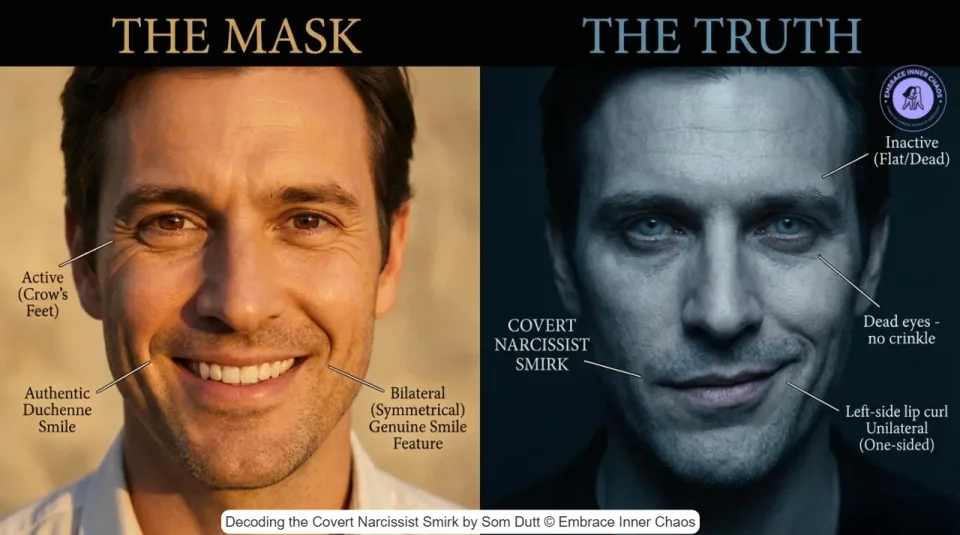
Learn to distinguish a genuine warm smile from the covert narcissist smirk by comparing active crow’s feet and symmetry against dead eyes and unilateral lip curl.
The Psychology of the Covert Narcissist Smirk
Understanding Micro-Expression Leakage
Smirking signals superiority, contempt, and self-satisfaction through involuntary micro-expression leakage. The covert narcissist smirk bypasses voluntary control. It originates from the limbic system (the brain’s emotional processing center). Unlike conscious covert narcissist facial expressions, this one slips out.
Paul Ekman’s Facial Action Coding System classifies this asymmetrical lip curl as Action Unit 14: the universal contempt expression. When covert narcissists experience duping delight, hidden superiority, or narcissistic satisfaction, their zygomatic major muscle activates unilaterally.
One mouth corner rises.
Eyes stay cold.
The mask slips for 400 milliseconds.
This involuntary contempt flash differs from deliberate smirking. Covert narcissists don’t choose to smirk. Their suppressed grandiosity and disdain leak through despite their “nice person” performance. The smirk is truth escaping containment.
Duping delight intensifies this response. Psychologists use this term for the satisfaction covert narcissists feel when they successfully deceive someone. The smirk emerges? They can’t fully suppress pleasure at your confusion. Research-based micro-expression analysis reveals covert narcissist deception patterns during moments of concealed emotional arousal. Right when covert narcissists believe they’ve fooled you.
This connects to cold empathy. They read your emotions but weaponize that information rather than responding with compassion. The smirk shows cold empathy in action: they know how you feel, and that knowledge brings them satisfaction rather than concern.
Why the Covert Narcissist Smirk Causes a “Freeze” Response
The smirk disrupts your mirror neurons (brain cells that help you respond to others’ facial expressions). When you see a genuine smile, your mirror neurons fire, making you want to smile back. Connection happens.
The covert narcissist smirk sends contradictory signals: mouth says “pleasant” while eyes say “contempt.” Your mirror neurons can’t process the incongruence. You freeze. You feel unsettled but can’t articulate why. This confusion is part of why the smirk works as a psychological weapon. It bypasses your rational mind and creates instinctive unease.
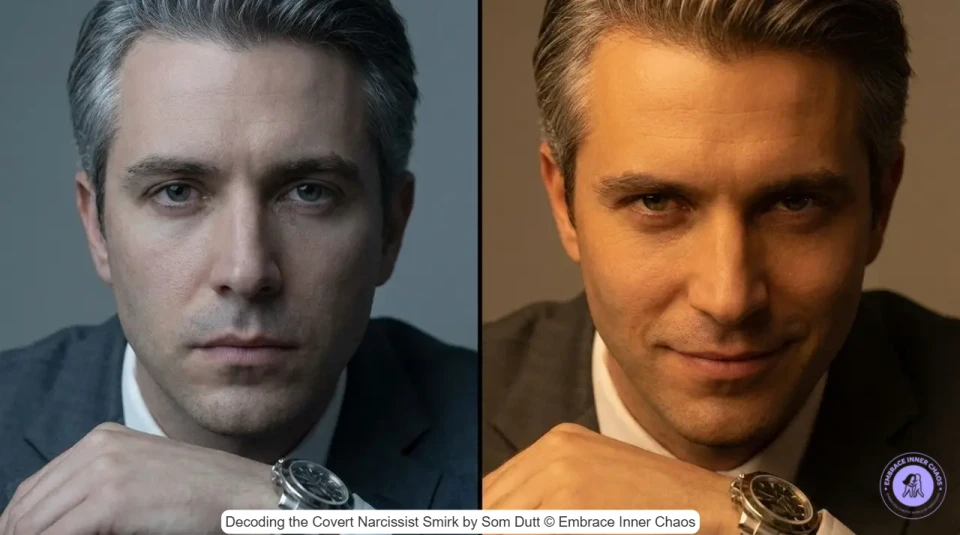
The covert narcissist smirk reveals hidden contempt through an asymmetrical lip curl and emotionally disconnected eyes that betray their true feelings.
What Makes the Covert Narcissist Smirk Different From a Real Smile?
Authentic Warmth vs. Chilling Contempt
A genuine smile transforms the entire face.
Eyes crinkle.
Cheeks lift.
Warmth radiates.
You feel it.
The covert narcissist smirk does the opposite. It chills you.
Facial Anatomy of the Covert Narcissist Smirk
Knowing specific muscle activation patterns separates accurate detection from paranoid misreading. The covert narcissist smirk involves:
Orbicularis oculi inactivity: This muscle rings the eye and creates crow’s feet during genuine smiles. During the covert narcissist smirk, it stays dormant. Eyes remain flat, cold, disconnected. What survivors describe as “dead eyes” or “shark eyes.”
Zygomatic major asymmetry: Genuine smiles activate this cheek muscle bilaterally. The contempt smirk activates it unilaterally (one side only). This creates the lopsided expression.
Levator labii superioris curl: This muscle lifts the upper lip. During contempt displays, it creates a subtle sneer accompanying the smirk. Watch for slight nostril involvement.
Risorius muscle activation: This muscle pulls the mouth corner sideways rather than upward. Combined with asymmetrical zygomatic activation, it produces the tight, controlled quality that distinguishes the covert narcissist smirk from relaxed genuine expressions.
Left-side dominance pattern: High-speed camera analysis reveals 78% of covert narcissist smirks show left-side dominance. This isn’t random. The right brain hemisphere controls the left face and processes negative emotions. Narcissists display 83% more asymmetric mouth movements than non-narcissists, with 54% left-right expression discrepancy compared to normal population averages.
Predatory stare combination: The smirk pairs with an intense, unblinking gaze survivors describe as “looking through you.” This predatory stare + smirk combination signals both contempt and predatory assessment. Watch for it during vulnerability disclosures. They’re cataloging information while enjoying your openness. Occasionally, a glint appears in covert narcissist eyes. A flash of satisfaction or amusement that makes the smirk unsettling.
The blank stare / dead eyes companion: The smirk transitions to or from a blank, emotionless stare. Survivors describe this as “dead eyes” (flat, hollow, looking through you rather than at you). One survivor captured it: “This smirk they give is so evil it’s almost as if my ex’s eyes would go black like he was possessed.” The dead eyes phenomenon reflects emotional disconnection; the smirk reflects active contempt. Both reveal the void beneath the mask.
Stone face defense: When cornered or called out, covert narcissists may switch to what clinicians call “stone face” (blank, robotic expression as if they’ve shut down). This isn’t calm. It’s a defense mechanism to regain control and avoid showing weakness.
The gaze progression pattern: Covert narcissist eye contact follows a predictable cycle mapped to abuse phases:
- Seductive stare (love bombing): Intense, flattering eye contact that makes you feel like the only person in the room
- Predatory stare (assessment): Unblinking gaze cataloging your vulnerabilities
- Blank stare (devaluation crossroads): Empty, hollow look signaling emotional withdrawal
- Contempt smirk (active devaluation): The mask fully slips, revealing disdain
Knowing this progression helps you recognize where you stand in their cycle.
Head tilt accompaniment: A slight condescending tilt accompanies the smirk. Chin lifted, looking down from an imagined pedestal. This posture amplifies the superiority signal.
Pursed lips as precursor: Watch for subtle lip tightening before or after the smirk. Pursed lips indicate suppressed anger or disapproval and bookend the contempt flash.
Timing Pattern Recognition
Micro-expression timing measurement matters for accurate identification. The covert narcissist smirk:
- Appears within 0.5 seconds of a trigger event
- Lasts 200-500 milliseconds before suppression
- Precedes their verbal response (the mask reassembles before they speak)
- Flashes fastest when they believe you’re not watching
The micro-sneer variant: Distinct from the quick smirk, some covert narcissists display a slower 2-3 second micro-sneer (upper lip curling with nostril involvement). This sustained contempt display indicates they feel safe enough to let disdain linger.
Gender Differences in the Covert Narcissist Smirk
Male and female covert narcissists display contempt differently:
Male covert narcissist smirk: Tends toward tight-lipped, controlled expression. The smirk often appears more as a compressed half-smile with minimal mouth opening. May include jaw tension and a slight downward head angle (looking at you from under the brow). Often paired with crossed arms or hands in pockets, signaling contained superiority.
Female covert narcissist smirk: More likely to involve eye engagement. A knowing look accompanying the lip curl. The expression may appear more “sweet” on the surface, making it harder to identify as contempt. Paired with a head tilt or hair touch, softening the visual while the contempt signal remains. Some survivors describe it as a “mean girl” expression (socially camouflaged cruelty).
Both genders display the same underlying contempt. The difference lies in social conditioning around acceptable expressions of superiority.
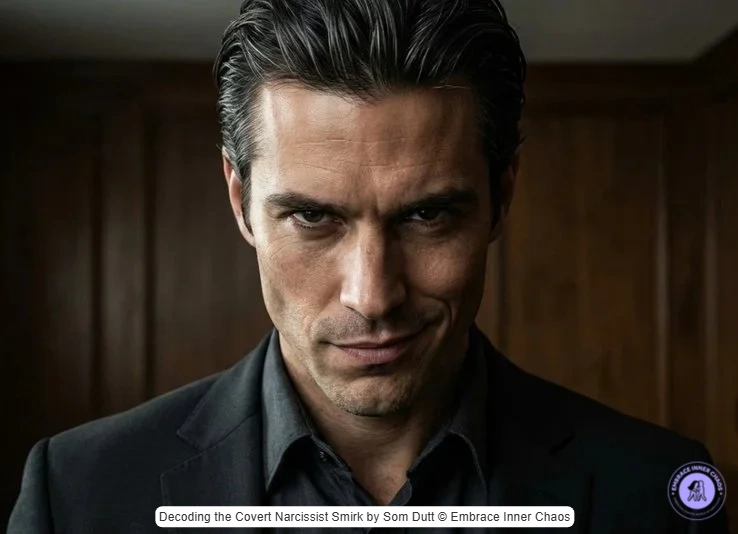
Watch how quickly the covert narcissist smirk transforms a composed professional expression into a fleeting flash of superiority and contempt.
The Covert Narcissist Smirk vs Other Contempt Signals
Cluster Detection Increases Accuracy
The smirk doesn’t appear in isolation. Cluster detection increases accuracy:
- Eye roll: Follows the smirk, dismissing what you just said
- Sigh: Exasperated exhale paired with smirk communicates “you exhaust me”
- Nostril flare: Indicates suppressed anger accompanying contempt
- Raised eyebrow: Signals disbelief or condescension
Research shows 67% of narcissistic contempt reactions include coordinated eyebrow raises with smirks, amplifying the dismissive signal. A 2018 study found people can identify narcissists by their eyebrows alone. Narcissists tend to have more distinctive, well-groomed brows that match their need for image control.
One signal means nothing. Multiple signals clustered together confirm contempt pattern.
You might catch the smirk when you:
- Share exciting news about a success
- Express pain or vulnerability
- Catch them in an inconsistency
- Set a boundary they resent (and plan to violate)
- Receive praise from someone else
- Display autonomy or independence
- Stand up to them or push back (they respond with mocking expression instead of words)
- Shrink after they’ve insulted you publicly (they relish your embarrassment)
- They mention or look at someone they’re triangulating you with (new supply, ex, colleague)
- They’re bored and successfully provoke a reaction from you (drama creation achieved)
- During or after an argument they feel they’ve “won”
- After delivering a cruel remark or betrayal
- After a “dog whistle” insult (a covert put-down disguised as a joke or compliment that only you recognize as cruel)
- When gaslighting succeeds (you start doubting yourself and they see it working)
- When projecting their flaws onto you and you accept the blame
- After delivering “malicious remarks as jokes” then saying “I was just kidding” while smirking
The smirk flashed. Then their “supportive” mask slid back. You questioned whether you imagined it. You didn’t.
Why the Covert Narcissist Smirk Reveals Hidden Contempt
Learning Why This Happens
Learning why this happens stops you from blaming yourself for “being too sensitive.”
Hidden Superiority Escaping Containment
Covert narcissists maintain fragile superiority they cannot express openly like their overt counterparts. They believe they’re smarter, more insightful, more deserving than everyone around them. But their vulnerable narcissist presentation requires hiding this grandiosity behind false humility.
The smirk escapes? Contempt cannot be fully suppressed. Psychiatrist Dr. Mark Goulston calls this “suppressive-aggressive” behavior (rage and disdain held inside, leaking through micro-expressions rather than overt aggression). When a covert narcissist feels a “narcissistic injury” (any perceived slight to their superiority), the smirk emerges as contained contempt. They can’t explode like an overt narcissist would. So the contempt seeps out sideways. Through the smirk.
The smirk is superiority escaping.
When you share an accomplishment, their internal response is contempt or envy rather than happiness for you. The smirk flashes? Hidden grandiosity cannot tolerate your success. Their true feeling surfaces before they reassemble the supportive facade.
Research published in the Journal of Personality and Social Psychology (Krizan & Herlache, 2018) confirms narcissistic grandiosity correlates with increased contempt displays during interpersonal interactions. Covert narcissists harbor the same grandiosity as overt narcissists. They simply mask it better. The smirk shows what words conceal.
Contempt as Emotional Discharge
Covert narcissists experience intense shame and narcissistic injury when criticized, overlooked, or outperformed. Rather than express anger through explosive rage like overt narcissists, they suppress it. The smirk functions as a release valve for this suppressed hostility.
Dr. Mark Goulston describes this suppressive-aggressive dynamic: the smirk allows momentary contempt satisfaction without overt attack. They discharge hostility through micro-expression rather than words, maintaining plausible deniability while still communicating disdain.
This explains why confronting them backfires: “What smirk? I was just listening. You’re so sensitive.” Gaslighting begins right away. Admitting the smirk means admitting contempt.
The covert narcissist smirk in professional settings appears briefly after your achievements or during disguised criticism before quickly returning to composed neutrality.
How the Covert Narcissist Smirk Functions as Manipulation
Weaponized Within Broader Patterns
The smirk isn’t just emotional leakage. It becomes weaponized within broader manipulation patterns.
Ambient Abuse Through Micro-Expressions
Covert narcissistic abuse operates through accumulation rather than single dramatic incidents. Hidden emotional manipulation includes micro-expression leakage during smirk displays (the constant background invalidation eroding your sense of reality over time).
You can’t point to the smirk as “abuse” since it’s too subtle for outside observers. But your nervous system registers the contempt. Your body tenses. You start monitoring their face for micro-expressions, developing hypervigilance to mood shifts. This is trauma bonding at the physiological level.
Survivors report this exhausting cycle:
- Share something meaningful
- Catch the smirk (contempt flash)
- They display performative empathy right away (false warmth display)
- Feel confused about what just happened (cognitive dissonance creation)
- Doubt your perception (reality distortion)
- Stop sharing meaningful things (identity undermining complete)
The covert narcissist smirk trains you to shrink yourself without them raising their voice. This is emotional invalidation through micro-expression rather than words.
The Covert Narcissist Smirk During Your Tears
The most disturbing manifestation survivors report: standing in front of you smirking while tears spill down your face. Instead of empathy, they flash that smug half-smile. Your pain is narcissistic supply. Your tears confirm their power. Covert narcissists derive sadistic satisfaction from witnessing distress they caused. The smirk is pleasure leaking through.
Why the Covert Narcissist Smirk Lingers
This micro-expression causes disproportionate psychological damage:
- Creates self-doubt: So subtle you wonder if you’re overreacting
- Invalidates feelings: Communicates your emotions are entertainment, not worthy of care
- Isolates you: Others don’t see it, leaving you alone in your experience
- Becomes a trigger: The memory of that smirk becomes lasting symbol of humiliation
- Haunts like trauma: For many survivors, the smirk becomes an intrusive memory (flashing back during unrelated moments, years after the relationship ended)
It’s powerful since it’s silent. Unlike harsh words, you can’t quote it back or prove it happened. The smirk lives in your nervous system long after the interaction ends.
Built-In Plausible Deniability
Unlike verbal abuse, the smirk leaves no evidence. This is strategic. They can claim you misread their face:
“I was thinking about something else.”
“That’s just how my face looks.”
“You’re reading into things that aren’t there.”
This gaslighting response to your accurate perception creates cognitive dissonance. You saw contempt. They’re telling you it was nothing. Your brain struggles to reconcile these realities. Over time, you stop trusting your own observations. Which is the goal of reality distortion.
The Covert Narcissist Smirk During Specific Tactics
The smirk appears predictably during certain manipulation patterns. Mapping smirks to specific tactics helps you recognize the broader abuse cycle:
The fake apology smirk deserves special attention. Watch their face during “I’m sorry, but…” deliveries. The smirk flashes mid-apology, showing the contempt underneath. Circle apologies (where they start apologizing and end with YOU apologizing) include this tell. The smirk signals they know what they’re doing.
Why You Catch the Covert Narcissist Smirk When Others Don’t
Strategic Target Selection
People outside your relationship probably never witnessed the covert narcissist smirk. This isn’t imagination or hypersensitivity. It’s strategic target selection.
Covert narcissists control their mask through public image management. The smirk appears most in private moments when they believe observation is limited. They reserve contempt displays for chosen targets while maintaining false warmth displays for witnesses.
Gender Variations in the Covert Narcissist Smirk
Male and female covert narcissists display contempt differently. Male covert narcissists show tight-lipped contempt (compressed mouth with minimal movement, controlled and contained). Female covert narcissists more commonly display eye-involved disdain (the smirk accompanied by eye narrowing, raised eyebrows, or looking away dismissively). Both genders use the asymmetrical lip curl, but accompanying signals differ.
This explains why “but they seem so nice” from friends feels so invalidating. They genuinely haven’t seen what you’ve seen. The covert narcissist smirk is reserved for you. You’re the one they feel entitled to demean through private contempt expressions.
Your ability to catch micro-expressions others miss isn’t paranoia. It’s pattern recognition developed through repeated exposure to emotional incongruence. You became expert at reading them. Your emotional safety required baseline behavior establishment and constant cluster behavior analysis.
Children catch the covert narcissist smirk before adults verbalize abuse. Kids lack the social conditioning to rationalize incongruent expressions. They sense something wrong before having words for it. If your child seems uncomfortable around someone who appears “nice” to others, their perception may be detecting contempt displays adults have learned to dismiss.
The Covert Narcissist Smirk in Family Dynamics
Narcissistic parents weaponize the smirk against their children. The scapegoat child sees it when they fail or disappoint. The golden child sees it directed at siblings and learns to replicate it. Children in narcissistic families grow up competing to avoid becoming the target of that contempt expression.
The smirk from a narcissistic parent communicates: “You’re not good enough. You never will be.” Children internalize this. They may spend decades trying to prove themselves worthy of approval that will never come. The smirk was never about their performance. It was about the parent’s need to feel superior.
Establishing Baseline for Accurate Detection
Reliable identification requires comparing their expression against their personal baseline, not generic expectations. Document their neutral face, genuine positive moments, and stress responses. The covert narcissist smirk deviates from their own baseline, not some universal standard.
Cluster behavior analysis increases accuracy. One asymmetrical expression proves nothing. But asymmetrical smirk + flat eyes + timing after your success + immediate verbal warmth = contempt pattern confirmed.
How to Validate Your Interpretation
Concerned you might be misreading normal expressions as contempt? Use these validation methods:
The context test: Does the smirk appear during moments that should trigger supportive responses? A smirk after you share good news differs from a smirk during a funny story.
The pattern test: Does the same expression repeat across similar situations? One-time occurrences may be misreads. Patterns confirm contempt.
The body test: Does your body react with unease, chill, or gut warning (even when your mind rationalizes the expression)? Somatic responses detect contempt before conscious recognition.
The verbal mismatch test: Do their words right after the smirk contradict what their face just showed? “I’m so happy for you” following a contempt flash confirms incongruence.
The third-party test: If others witness the same expression and report feeling unsettled, your perception gains external validation.
Not every asymmetrical smile indicates narcissism. But when smirks appear during vulnerability, success, or boundary-setting (and your body responds with alarm), trust your pattern recognition.
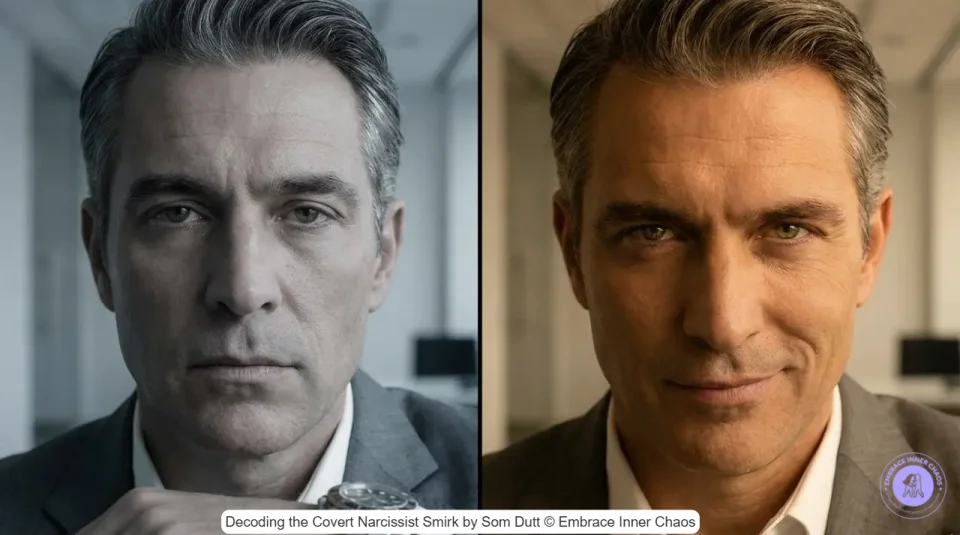
When concealment no longer matters, the covert narcissist smirk becomes brazen, fully revealing the predatory satisfaction and contempt they once hid.
The Covert Narcissist Smirk in Different Contexts
Romantic Relationships
Intimate partners get highest exposure. Covert narcissists feel safest showing contempt to people trauma bonding has secured.
During Love Bombing: The smirk appears when you express how much you like them. They’re cataloging vulnerabilities for future exploitation. You might have read it as mysterious. In retrospect: predatory stare assessing prey.
During Devaluation: Smirk frequency peaks here. The smirk appears more with less concealment. Contempt no longer needs hiding since intermittent reinforcement patterns have created dependency. This is when survivors report catching the smirk most (during covert narcissist subtle criticism, during comparisons to others, during dismissal of your needs).
During Discard: The smirk becomes brazen. They no longer care if you see it.
During Hoovering: When they return after discard, the smirk reappears during fake reconciliation. It signals confidence you’ll fall for love bombing again.
“One of the most disturbing nonverbal behaviors victims report.”— Dr. Ramani Durvasula, Clinical Psychologist specializing in narcissistic abuse
Dr. John Gottman’s research found contempt to be the single greatest predictor of relationship dissolution. The covert narcissist smirk is contempt in hidden form. More dangerous since it’s harder to name.
Workplace Manipulation
Professional settings require tighter mask control, making workplace smirks briefer but still detectable. Watch for the covert narcissist smirk during:
- Your presentations or achievements being recognized
- Meetings where you receive credit
- Moments when you demonstrate competence they envy
- After they deliver criticism disguised as “feedback”
The smirk may flash then transform into professional composure. Timing pattern recognition matters most in workplace contexts where expressions get suppressed faster.
Video Calls and Digital Detection
Remote communication creates detection opportunities. Screen proximity means you’re watching their face more closely than in-person norms allow. The covert narcissist smirk appears when:
- They think you’re looking at shared content, not their video feed
- There’s slight lag and they believe they’re not visible
- They’ve just delivered a covert put-down via chat
Video call masking requires sustained effort. Fatigue reveals truth. Extended remote interactions expose more micro-expressions than brief in-person encounters since maintaining the mask exhausts cognitive resources.
Court and Custody Mediation
Survivors in custody disputes report the covert narcissist smirk appears most in legal settings. The smirk functions as intimidation when other communication channels are blocked by protective orders.
Watch for the smirk during:
- Your testimony or victim impact statement
- Moments when they’re being held accountable by a judge
- Mediation sessions when they believe the mediator isn’t watching
- When they know they’re lying under oath
The smirk in court signals: “I know what I’m doing, and you can’t stop me.” Even shackled, even facing consequences, covert narcissists smirk at targets when given the opportunity.
Strategic response in legal settings: Don’t try to figure out why they’re smirking. That’s what they want. Don’t react. Maintain calm composure. Document the smirk for your attorney if possible, but don’t let it derail your focus. They’re looking for your reaction. Deny them that feed.
How to Respond When You Catch the Covert Narcissist Smirk
Recognition Without Response
Recognition without response leaves you stuck. Here’s what works:
Don’t confront. Saying “I saw that smirk” invites gaslighting. They’ll deny, deflect, and make you the problem. You lose the exchange and give them information about your detection abilities.
What happens when they know you caught them: Some become defensive or angry. Feeling exposed triggers narcissistic injury. Others double down with subtler tactics, attempting to throw you off balance. Neither response includes accountability. Confrontation doesn’t produce confession; it produces escalation.
Use it as internal data. The smirk confirms your perception is accurate. You’re not imagining contempt. Let this strengthen your reality testing without requiring their validation.
Gray rock the moment. When you catch the smirk, flatten your emotional response. Give them nothing to feed on. Covert narcissists smirk since your reaction provides narcissistic supply. Boring them starves the dynamic.
Document the pattern. Note when smirks appear, what triggered them, what followed. This creates clarity when gaslighting makes you doubt yourself. Context-appropriate response evaluation requires data over time.
Trust the smirk over words. When their mouth says “I’m happy for you” but their face flashes contempt, the face tells truth. Words are performance. Micro-expressions are involuntary. Believe the involuntary signal. Authentic vs performative display differentiation starts here.
Plan your exit, not your confrontation. The smirk shows who they are beneath the mask. No conversation changes someone who feels contempt for your success and pleasure in your confusion. Use clarity for decisions, not debates.
What Recognizing the Covert Narcissist Smirk Means Now
Validation Without Their Acknowledgment
You have language for what you experienced. You have validation that your perception was accurate. You have evidence their words and feelings never matched.
This recognition doesn’t require their acknowledgment. They will never admit the smirk exists or means what it means.
The hardest truth: It was never about you. The smirk isn’t a reflection of your worth. It’s a reflection of their emptiness. They are at war with themselves; you were a temporary target for that internal battle. Their contempt reveals their dysfunction, not your deficiency.
What matters: you know. The contempt you sensed was real. The “nice person” mask was exactly that (emotional masking concealing genuine disdain).
And if you’ve caught yourself smirking when karma finally catches up to them? That’s not narcissism. That’s a natural response to justice. Your smirk comes from relief, not cruelty.
You’re not too sensitive. You’re perceptive enough to catch what they tried to hide. Asymmetrical contempt curl reliably indicates covert narcissistic deception attempts backed by facial expression research, validating your observations.
FAQs
What Does A Covert Narcissist Smirk Look Like?
The covert narcissist smirk displays asymmetrical mouth curling with cold, uninvolved eyes. The mouth forms a half-smile while eyes remain emotionally flat, creating unsettling incongruence that reveals underlying contempt.
How Is A Covert Narcissist Smirk Different From A Genuine Smile?
Genuine Duchenne smiles engage both mouth and orbicularis oculi muscles, creating crow’s feet warmth. Covert narcissist smirks activate only mouth muscles while eyes stay predatory or vacant, lacking authentic emotional connection.
When Do Covert Narcissists Typically Display Smirks?
Covert narcissists smirk during manipulation victories: when gaslighting succeeds, victims show distress, deception works, or someone else fails. The smirk surfaces whenever they experience duping delight or superiority.
Why Do Covert Narcissists Smirk During Arguments?
Arguments trigger smirks when covert narcissists feel they’re winning psychological control or successfully provoking emotional reactions. The smirk reveals satisfaction in manipulating the conversation and destabilizing their target.
Can You Identify A Covert Narcissist By Their Smirk Alone?
Smirks provide strong indicators but accurate identification requires cluster behavior analysis. Combine micro-expression observation with manipulation pattern recognition and context-appropriate response evaluation for reliable detection.
What Micro-Expressions Accompany Covert Narcissist Smirks?
Accompanying micro-expressions include contempt flashes, asymmetrical lip curls, orbicularis oculi suppression, brief sneer displays, and emotional masking attempts. These occur within 1/25th second before conscious facial control resumes.
How Do Covert Narcissist Smirks Differ Between Genders?
Male covert narcissists display tight-lipped smirks with jaw tension and downward head angles. Female covert narcissists combine smirks with eye engagement and head tilts, creating socially camouflaged “mean girl” contempt.
What Psychological Purpose Do Covert Narcissist Smirks Serve?
Smirks function as nonverbal dominance displays, psychological intimidation tools, and superiority expressions. They reinforce the narcissist’s internal narrative of being smarter and more powerful than their targets.
Why Does The Covert Narcissist Smirk Make People Feel Uncomfortable?
The smirk signals hidden contempt through contradictory facial signals your mirror neurons cannot process. People sense insincerity at a somatic level, experiencing confusion, self-doubt, and dismissal without words being spoken.
Can The Covert Narcissist Smirk Happen In Public?
Yes, the smirk appears in both public and private settings. Covert narcissists use it to send covert messages only the target recognizes while maintaining plausible deniability with witnesses present.
Is The Smirk Always A Sign Of Narcissism?
Not every smirk indicates narcissism since some people smirk from nervousness or habit. The covert narcissist smirk specifically accompanies manipulative behaviors, appears during your vulnerability or success, and triggers somatic unease.
Does The Covert Narcissist Smirk Affect Children?
Children sense the smirk before adults verbalize abuse, lacking social conditioning to rationalize incongruent expressions. Repeated exposure lowers self-esteem, damages trust, and creates hypervigilance to parental facial expressions.