


Last updated on December 28th, 2025 at 01:26 am
Do Narcissists Know They Are Hurting You? You may see their actions as cold or planned. Research shows narcissists often know you are hurt but ignore it. Some studies say they do not feel much emotional empathy and do not care about your feelings.
This lack of empathy depends on what they want and the situation. If you feel ignored or tricked, you are not the only one. You deserve to understand and get help. Let’s look at ways to keep yourself safe.
TL;DR
Narcissists usually know when they hurt you, but they ignore your pain. They do not have emotional empathy, so they do not care about your feelings.
Narcissists use tricks like gaslighting and blame-shifting to control and confuse you.
Watch for warning signs, like no remorse and breaking your boundaries, to help you stay safe.
Awareness of Harm

Self-Perception
Distorted Image
Narcissists often see themselves in a way that is not real. They make themselves look better to feel good about who they are. This makes it easier for them to ignore when they hurt others. Many experts say narcissists know they want attention but do not know why. They think about what they are good at and forget their mistakes. You might think they are sure of themselves, but they can feel very empty inside.
Denial
Narcissists use denial so they do not have to face the pain they cause. If you tell them they hurt you, they might blame you or someone else. They almost never say they did something wrong. Denial and blaming help them not feel guilty. You might get upset when they do not take the blame. This denial stops them from seeing how their actions hurt people.
Selective Awareness
Sometimes narcissists notice they hurt others, but only if it matters to them. They choose what they want to see. Studies from Washington University show narcissists can say they are narcissists. But they do not really get how their actions hurt people.
They often say their actions are needed or helpful. You may ask, “Do Narcissists Know They Are Hurting You?” The answer is not simple. They know some things but ignore other things.
Noticing Pain
Signs of Awareness
You might see signs that narcissists notice your pain. If they lose attention or feel scared, their fake confidence can break. This can look like sadness or anger. They react a lot to emotional pain in themselves and others. Their need to be in charge shows they notice feelings around them.
Narcissists act like they are better to hide feeling not good enough. Denial and blaming help them not face their own pain.
Ignoring Cues
Even if narcissists see you are hurt, they often do not care. They think about what they want first. They may get mad or blame you instead of helping. Because they lack affective empathy, they do not feel your feelings. You might see them act like they do not care when you are sad.
Research Findings
New studies show narcissists can understand when you are hurt, but they do not care much. Research from 2000 to 2025 shows this difference. Narcissists have brains that react a lot to social pain, especially when left out. This strong reaction is linked to bad mental health.
Finding | Description |
|---|---|
Narcissism and Social Pain | Narcissists’ brains react strongly when they feel left out. |
Neural Activity | Their brains show a lot of activity in social pain areas. |
Implications | This strong reaction is linked to mental health problems. |
Behavioral Cue | Description |
|---|---|
Displays of superiority | Narcissists act better than others to hide feeling bad inside. |
Need for control | They want to control feelings, showing they notice others’ emotions. |
Defense mechanisms | Denial and blaming help them avoid pain, showing they notice it. |
Narcissists may feel empty and weak, so they notice these feelings in others.
They often get angry or blame others when they feel pain, showing they see pain around them.
Their fake confidence can be a way to hide feeling unwanted, which means they notice others’ struggles.
You might find it hard to understand why they act this way. Experts agree: narcissists can see pain but often do not care. They only notice what helps them feel good about themselves.
Do Narcissists Know They Are Hurting You
Conscious Actions
Manipulation
You might see narcissists use manipulation to get their way. They change words and play tricks to confuse you. This behavior seems planned. Narcissists know their actions hurt you, but they care about themselves. They use guilt or shame to control you.
If you ask, “Do Narcissists Know They Are Hurting You,” their actions show they know. They keep doing hurtful things even after you say how you feel.
Narcissists act in emotionally abusive ways because they care more about themselves.
They blame others and make excuses, which can make you feel confused or guilty.
If you tell them they hurt you, they may keep going, showing your feelings do not matter to them.
Exploiting Emotions
Narcissists know how to use your feelings against you. They act caring when they want something, then ignore you when you need help. You might feel like your feelings are not important. Narcissists look for ways to keep you unsure. They use your fears and hopes to stay in control. This can make you doubt yourself and feel weak.
Manipulation Tactic | Description | Impact on You |
|---|---|---|
Gaslighting | Denying your reality | Self-doubt |
Blame-shifting | Making you feel responsible | Guilt |
Withholding affection | Using love as a reward | Anxiety |
Playing victim | Turning the tables | Confusion |
Prioritizing Self
Narcissists put themselves first. They do not think about how their choices hurt you. If you ask, “Do Narcissists Know They Are Hurting You,” you see they do. They pick actions that help themselves, even if it hurts you. Their emotional immaturity makes them protect themselves. You may notice they ignore your pain and care about their own comfort.
Narcissists act for themselves. They do not think about your feelings, even when you say you are hurt.
Lack of Remorse
No Empathy
You may wonder why narcissists do not feel sorry after hurting you. They lack empathy. They do not connect with your feelings. Even when they see you are upset, they do not feel your pain. This makes it easy for them to keep hurting you. Narcissists often get angry when you challenge them. They protect their self-image instead of caring about your feelings.
Narcissists do not feel empathy and can hurt others without feeling bad.
They get angry when embarrassed or blamed, which helps them avoid guilt.
Their emotional reactions are ways to protect their self-esteem.
Emotional Detachment
Narcissists often seem far away emotionally. You may feel like you cannot reach them, no matter what you say. They avoid close connections and keep you at a distance. This helps them avoid feeling responsible for your pain. You might try to get their approval, but they set high standards that are hard to meet. Experts say stopping the search for their approval helps you break free.
Emotional Detachment Sign | Description | How It Affects You |
|---|---|---|
Avoiding responsibility | Refusing to admit fault | Frustration |
Withholding affection | Not showing care or love | Loneliness |
Setting high standards | Making you work for approval | Anxiety |
Ignoring your needs | Not listening to your feelings | Sadness |
Focusing on your own growth and interests helps you find yourself again. Getting help from a therapist can give you ways to cope and heal.
Expert Insights
Experts say narcissists have trouble seeing how they affect others. Their fears and insecurities make them act selfishly. They often attack instead of saying sorry when betrayed. This lack of accountability makes change hard for them. Many studies show narcissists have deep habits that cause repeated harm. You may feel powerless, but you can learn to protect yourself.
Expert Finding | Description | How It Affects You |
|---|---|---|
Low self-awareness | Narcissists do not see their impact | Repeated harm |
Defense mechanisms | Anger and blame protect self-image | Lack of remorse |
Emotional immaturity | Selfish choices over empathy | Ongoing pain |
Therapy helps | Professional support aids recovery | Healing and growth |
When you ask, “Do Narcissists Know They Are Hurting You,” you see they often do, but they do not care. Their actions are on purpose, and their lack of remorse is part of who they are. You deserve support and understanding as you move forward.
Empathy Deficit
Types of Empathy
Cognitive vs. Emotional
You might wonder why narcissists seem to get your feelings but still hurt you. There are two main kinds of empathy. Cognitive empathy means knowing what someone feels. Emotional empathy means sharing those feelings. Narcissists often have low emotional empathy. They can tell what you feel, but they do not care about your pain. Sometimes, they use this skill to get what they want.
Narcissists usually have low emotional empathy.
They can understand feelings in others, but use this skill to trick people.
This is not the same as autism, where people may miss social cues but do not want to hurt anyone.
Impact on Others
When narcissists lack empathy, it causes problems in relationships. You may feel ignored or misunderstood. Narcissists often use your feelings against you. This can make you feel anxious, sad, or unsure of yourself. Their lack of empathy makes it hard for you to trust them or feel safe.
Empathy Type | Narcissist Behavior | Effect on You |
|---|---|---|
Cognitive Empathy | Manipulates your feelings | Confusion |
Emotional Empathy | Ignores your pain | Loneliness |
Empathic Concern | Lacks caring responses | Anxiety |
Study Results
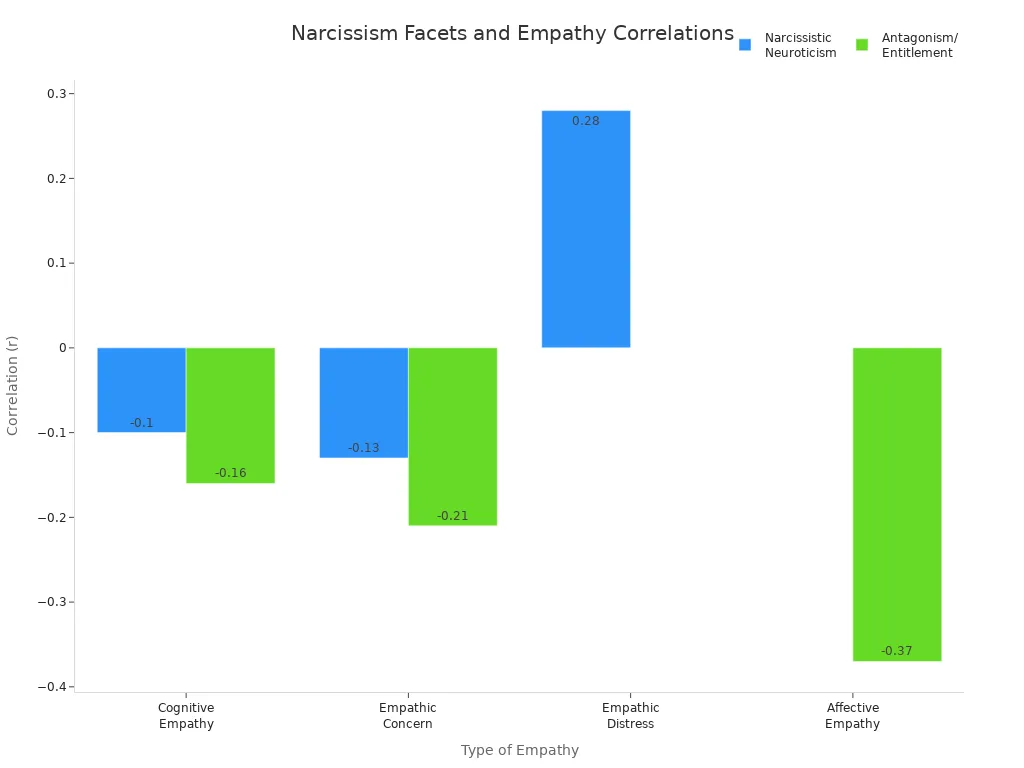
Research shows there are clear links between narcissism and empathy problems. The table below shows how different parts of narcissism relate to empathy.
Facet of Narcissism | Type of Empathy | Correlation (r) |
|---|---|---|
Narcissistic Neuroticism | Cognitive Empathy | -0.10 |
Narcissistic Neuroticism | Empathic Concern | -0.13 |
Narcissistic Neuroticism | Empathic Distress | 0.28 |
Antagonism/Entitlement | Affective Empathy | -0.37 |
Antagonism/Entitlement | Cognitive Empathy | -0.16 |
Antagonism/Entitlement | Empathic Concern | -0.21 |
Antagonism/Entitlement | Empathic Distress | N/A |
Can Empathy Improve?
Therapy
Therapy can help some narcissists get better at empathy. Therapists use special ways to help patients notice and understand feelings. Working together helps the most. Validation helps people feel less defensive. Therapists ask questions to help patients think about themselves.
Therapy can help narcissists change how they use empathy.
Working together helps patients learn about their own and others’ feelings.
Validation and clarification help people respond better.
Asking questions helps people think about their actions.
Limits of Change
You may hope for change, but there are limits. Narcissists often do not want therapy. Their big egos and low self-esteem make trust hard. Small problems can make them angry. Many quit therapy early.
Narcissists may not want to try therapy.
Their traits make it hard to build trust.
Angry reactions can stop treatment fast.
Therapists may have trouble with their own feelings toward narcissists.
Narcissists rarely talk about their own problems, making therapy tough.
There are not many proven ways to treat narcissism.
Expert Views
Mentalization-based treatment tries to help people focus on others, not just themselves. Stigma and strong feelings can slow progress. Therapists must balance being kind and challenging patients. You may see that change is slow and hard. Support and patience help you deal with these problems.
You deserve relationships where people care about your feelings. Therapy can help, but change takes time and effort.
Intentional vs. Unintentional Harm
When you deal with a narcissist, you might wonder if they hurt you on purpose or by accident. Knowing the difference helps you protect yourself and understand your feelings.
Deliberate Harm
Manipulation Tactics
Narcissists use planned ways to control and hurt you. These actions are not mistakes. You might notice:
They suddenly act cold or stop showing love to punish you.
They use guilt or shame to make you do things.
They embarrass you in public or spread rumors about you.
They keep you away from friends or family so you depend on them.
They control your money or things you need.
They check your messages or change facts to confuse you.
Gaslighting makes you question your memory or reality.
They give lots of love, then reject you to keep you unsure.
They bring in others to make you jealous or cause drama.
They ignore you to make you feel nervous.
These tricks can make you feel weak and unsure about yourself.
Seeking Control
Narcissists want to be in charge. They may:
Blame you for things they do, like lying or cheating.
Pretend to be the victim so you feel bad for them.
Tell lies about you to others, especially during fights.
You might feel like you always have to defend yourself or prove your side.
Research Examples
Studies show narcissists use these tricks to keep control. They know these actions hurt you, but they still do them to get what they want.
Unconscious Harm
Lack of Reflection
Sometimes, narcissists hurt you without meaning to. They do not think about how their actions affect you. They focus on their own needs. They may act quickly or get angry, not seeing the pain they cause.
Habitual Behavior
These harmful actions can become habits. Narcissists may not plan to hurt you, but their lack of empathy and self-awareness causes problems again and again. You might see the same things happen, even when you ask them to stop.
Studies
Research shows people with high narcissistic traits have trouble understanding emotions and thinking about others. The table below shows what scientists found:
Study | Findings |
|---|---|
Fan et al. (2011) | Narcissists have trouble with emotions and show less brain activity for empathy. |
Ash et al. (2023) | Brain scans show changes in areas for feelings and social understanding. |
Stolz et al. (2021) | Narcissists think less about helping others and have less brain activity for conflict. |
Even if a narcissist does not mean to hurt you, the pain is still real. Their lack of thinking and empathy makes it hard for them to change.
Narcissists often do not mean to hurt you, but their actions can still cause pain.
They do not think about how their behavior affects others, which leads to unintentional harm.
Acting quickly and getting angry are common, and these can hurt others without meaning to.
Knowing the difference between intentional and unintentional harm helps you set boundaries and protect yourself.
Factors Affecting Awareness
Personality Types
Grandiose
Grandiose narcissists act bold and seem very sure of themselves. They like to show off and want special treatment. These traits make them care less about your feelings. Grandiose narcissists act entitled and ignore what you feel. They focus on their own needs first. Research says their behavior is easy to notice. They do not hide what they want. This means they do not care much about the harm they cause.
Vulnerable
Vulnerable narcissists act in a different way. You might think they are shy or sensitive. They often feel unsure about themselves. This makes them react strongly when criticized. If you tell them they hurt you, they may get upset or act like a victim. Their own pain makes it hard for them to see how they hurt others.
Vulnerable narcissists use quiet tricks, so it is hard to spot the harm. Dr. Ramani Durvasula says these people act needy, which hides their real plans. You might not notice how much their actions hurt because they seem weak.
Differences
Grandiose and vulnerable narcissists see harm in different ways. Grandiose types ignore your pain and think about themselves. Vulnerable types may not see the harm because they are focused on their own problems. Both can hurt you, but they do it in different ways.
Type of Narcissist | Awareness of Harm | Typical Behavior | Impact on You |
|---|---|---|---|
Grandiose | Low | Overt, entitled | Obvious, direct |
Vulnerable | Clouded by insecurity | Subtle, manipulative | Hidden, confusing |
Environment
Childhood
Your childhood shapes how you see yourself and others. Family life is important for building narcissistic traits. If you got too much praise or harsh criticism, you may have low self-esteem. Kids with narcissistic parents often feel ignored. This can make it hard to feel empathy or understand emotions. Emotional tricks in childhood can cause problems later in life.
Evidence Description | Impact on Narcissism |
|---|---|
Family environments significantly influence narcissistic traits. | Shapes future relationships and self-perception. |
Excessive praise or harsh criticism from parents can lead to narcissistic behaviors. | Affects self-esteem and emotional regulation. |
Children of narcissistic parents often face emotional neglect. | Results in lack of empathy and emotional awareness. |
Emotional manipulation during childhood can have long-term psychological effects. | Leads to difficulties in relationships and self-esteem. |
Narcissistic parenting impacts emotional development. | Hinders recognition and expression of emotions. |
Social Influence
Social influences change how narcissists see harm. Social media rewards people for getting attention. Likes and follows make people want approval. This can make narcissistic traits stronger. Culture also shapes how people see narcissism and harm. In some places, showing off is seen as ambition. In other places, group harmony matters more.
Culture
Culture affects how narcissism looks and how harm is noticed. Individualistic cultures push people to succeed and compete. This can make it hard to tell healthy ambition from harmful narcissism. Collectivist cultures want group harmony, which can hide narcissistic actions.
Cultural Context | Influence on Narcissism | Impact on Awareness of Harm |
|---|---|---|
Individualistic | Traits like self-promotion are often seen as ambition, leading to higher tolerance. | Blurs the line between healthy ambition and harmful narcissism, affecting self-awareness. |
Collectivist | Emphasizes group harmony, potentially suppressing overt narcissism. | Can mask underlying narcissistic tendencies, complicating recognition of harmful behaviors. |
Individualistic cultures make people compete and want success, which can increase narcissistic traits.
Social media makes people want likes and attention, which can make narcissistic behavior worse.
Culture shapes how people see narcissism and harm, changing how it is noticed and handled.
Your personality, childhood, and culture all affect how you see harm and respond to narcissistic behavior. Knowing these things helps you protect yourself and spot unhealthy patterns.
Justifying Behavior
Rationalizations
Narcissists often try to explain away their hurtful actions. They do not like to admit they are wrong. Instead, they use excuses to protect how they see themselves. These tricks can make you question your feelings and what is real.
Blaming Others
Narcissists blame other people for their mistakes. You might hear things like, “It’s your fault,” or “You made me do this.” This helps them not feel guilty. They want you to think you caused the problem. This can make you feel confused and think you did something wrong.
Minimizing Harm
Narcissists make their actions seem less serious. They might say, “Nobody gets hurt,” or “It’s not a big deal.” This makes their behavior look okay. You may start to doubt your pain or think you are just being dramatic.
Entitlement
Narcissists think they should get special treatment. They believe rules do not matter for them. You might hear, “I deserve this,” or “I’m different.” This lets them say it is fine to hurt others. They think their needs are more important than yours.
Here is a table with common excuses:
Rationalization Type | Explanation |
|---|---|
Blaming others | Puts the blame on others to avoid trouble. |
Minimizing harm | Says nobody gets hurt to make it seem okay. |
Euphemistic language | Uses softer words to hide bad actions. |
Narcissists also use sneaky ways to control and confuse you:
Gaslighting: They make you doubt what is true.
Micromanipulations: Small tricks that keep you unsure.
Cognitive Dissonance
You may feel mixed up when a narcissist’s words and actions do not match. This feeling is called cognitive dissonance. It happens when you believe two things that do not fit together. Narcissists use this to keep you confused and needing them.
Self-Justification
Narcissists make up reasons for what they do. They tell stories to make their actions seem okay. You might hear, “I had no choice,” or “Anyone would do this.” This helps them not feel bad about their choices.
Defense Mechanisms
Narcissists use tricks to protect their self-esteem. They deny, make excuses, or blame others. These habits stop them from facing the truth. You may see them get angry or defensive if you question them.
If you feel mixed up or doubt yourself, you are not alone. Many people feel cognitive dissonance after dealing with narcissists.
Victims often feel unsure and confused. Narcissists create many stories, so it is hard to trust yourself. You may find writing in a journal or talking to a therapist helps you understand your feelings.
Here are some ways to handle cognitive dissonance:
Getting support and hearing your reality helps you feel stronger.
Telling your story in therapy or writing can clear up confusion.
Learning about narcissistic behavior gives you ways to protect yourself.
Expert Quotes
Experts say, “Positive regard and psychoeducation are crucial for recovery from the emotional turmoil caused by narcissistic behavior.” You deserve help and kindness as you heal. Remember, your feelings matter and are real.
Recognizing Harm
Red Flags
It can be hard to spot harm from a narcissist. You might see warning signs that show they know they are hurting you. These red flags show up in what they say and do.
No Remorse
Narcissists almost never feel bad after hurting someone. Sometimes, they brag about hurting people. You may see them laugh when someone is upset. They tell stories about revenge and seem proud. This can make you wonder if your feelings matter.
Red Flag Description | Explanation |
|---|---|
Pride in malicious actions | Narcissists share revenge stories and do not feel sorry. |
Manipulation of emotions | They like to control feelings and seem happy when others are sad. |
Enjoyment in others’ distress | They may laugh or smirk when someone is hurt or emotional. |
Boundary Violations
Narcissists often ignore your boundaries. They might read your messages without asking. Sometimes, they show up when you do not want them to. They push you to do things you do not want. If you set limits, they may get mad or blame you. This shows they do not respect your needs.
Manipulation
Narcissists use tricks to control how you feel. They twist your words and deny what they said. This is called gaslighting. You might feel confused or unsure about what is true. They use guilt or shame to get what they want. After a while, you may doubt your own choices.
If you see these red flags, listen to your gut. You deserve respect and honesty from others.
Myths and Facts
Common Myths
Many people believe things about narcissists that are not true. These ideas can make you feel lost or sad. Let’s look at some myths and what research says.
“Unaware of Harm”
Some people think narcissists do not know they hurt others. This is not always right. Research shows narcissists often do not see their actions as bad. They might think what they do is normal and blame others. Some do not notice the pain they cause, but others know and ignore it.
They may think their actions are fine and blame others.
Some do not notice the pain, but some know and do not care.
“All Are Evil”
Another myth says all narcissists want to hurt people. This is not true. Narcissists have different reasons for what they do. Some act because they feel unsure or have habits, not because they want to be mean. Not every narcissist tries to cause pain.
Not all narcissists want to hurt others.
Many act from feeling unsure or not knowing themselves.
Their actions can still hurt, but reasons are different.
“Can Be Changed”
You may hope narcissists can change if you try hard. Change can happen, but it is slow and rare. Therapy helps some narcissists learn empathy, but many do not want help. You cannot make someone change if they do not want to.
Change is possible but very hard.
Therapy helps some, but many do not want it.
You cannot force someone to change if they refuse.
Research Insights
Nuanced Findings
Research shows narcissists are not always unaware of harm. Dr. Ramani Durvasula says narcissists can change how they act depending on where they are. A narcissist may act nice in public but get angry at home. This means they know how their actions affect people and can control how they look.
Dr. Ramani Durvasula says, “Narcissists can change how they act depending on the situation. They may seem nice in public but show anger in private, making their partners feel alone.”
Expert Quotes
Experts share ideas about how narcissists think and act. Here are some quotes to help you understand:
Quote | Expert |
|---|---|
“When you’re dealing with a narcissist, remember: the rules only apply to you, never to them.” | Dr. Ramani Durvasula |
“Narcissists will destroy your sanity to validate their lies.” | Tracy Malone |
“They gaslight you to the point where you question your own reality.” | Shahida Arabi |
“Narcissists don’t want partners. They want puppets.” | Unknown |
“Narcissists are like parasites; they feed off your energy, your kindness, your need to be understood.” | Shahida Arabi |
“You are not crazy. You are being emotionally manipulated.” | Dr. George Simon |
“Gaslighting is emotional abuse cloaked in manipulation.” | Dr. Stephanie Sarkis |
“Narcissists try to destroy your life with lies because theirs can be destroyed with the truth.” | Nikita Gill |
“A narcissist paints a picture of themselves as being the victim or innocent in all aspects.” | Dr. Ramani Durvasula |
Victim Implications
You may feel confused or unsure after dealing with a narcissist. Their actions can make you doubt what is real. Remember, you are not alone. Experts say emotional tricks can cause anxiety, self-doubt, and stress. Knowing myths and facts helps you stay safe and get help.
Tip: Trust your feelings and ask for help if you see signs of manipulation. You deserve respect and care.
Conclusion
You can see narcissists know when they hurt you. They do not show much empathy or feel sorry. They care about themselves and ignore your feelings.
They only notice your pain if it helps them. You might see them blame others or make their actions seem small. They may think they should get special treatment. Seeing these signs helps you stay safe.
Work on feeling better and taking care of yourself.
Know your feelings are real and should be respected.
Keep your boundaries strong and remember change is hard.
Your feelings and health are very important.
Frequently Asked Questions
Why do narcissists blame others?
Narcissists blame others to protect how they see themselves. They do not want to feel guilty or take responsibility. You might hear, “It’s your fault,” even if it is not true.
How can you protect yourself from narcissistic harm?
Set clear boundaries to keep yourself safe. Trust your own feelings. Get help from friends, family, or a therapist. Focus on taking care of yourself.
What are signs of narcissistic manipulation?
You might notice gaslighting, blame-shifting, or not getting affection. Narcissists twist words and make you doubt yourself. These tricks are common ways they control people.
Should you confront a narcissist about their behavior?
Talking to a narcissist can make them angry or blame you. You can share your feelings, but keep yourself safe. Sometimes, staying away is the best choice.