Som Dutt Image on Embrace Inner ChaosSom Dutt
Publish Date

How To Deal With A Covert Narcissistic Sister: 17 Protection Strategies

FInd how to deal with a covert narcissistic sister. Set boundaries, protect your mental health and find practical steps to handle manipulation and family stress.

Strategies On How To Deal With A Covert Narcissistic Sister by Som Dutt From Embrace Inner Chaos
Contents show
How To Deal With A Covert Narcissistic Sister

Learning how to deal with a covert narcissistic sister requires a strategic approach. Not more love, patience, or understanding. Unlike overt narcissism, covert narcissism hides behind false humility while using gaslighting, triangulation, passive-aggressive comments, guilt-tripping, and victim playing to maintain control over sibling relationships.

Family gatherings shouldn’t leave you questioning your sanity, yet that’s exactly what happens when you have a covert narcissistic sister. She may adopt a victim mentality, portraying herself as misunderstood while deflecting responsibility for her actions. The covert narcissist sister doesn’t scream. She destroys you while smiling, leaving you questioning your own reality.

This Guide Covers 17 Proven Protection Strategies:

  1. Gray rock method
  2. Information diet
  3. Emotional boundaries
  4. Physical boundaries
  5. Time-based boundaries
  6. Information boundaries
  7. JADE avoidance
  8. Broken record technique
  9. Boundary scripts
  10. Documentation system
  11. Strategic ally partnerships
  12. Exit signal protocols
  13. Family gathering prep
  14. Family gathering navigation
  15. Low contact framework
  16. No contact implementation
  17. Flying monkey management

About the Author

I’m Som Dutt, a Certified Coach specializing in covert narcissism, NPD, and narcissistic abuse recovery, with 7+ years of experience guiding 1,400+ survivors. My work blends research-backed insights with practical strategies for healing from toxic relationships and complex family dynamics.

LinkedIn

TL;DR

  • She craves narcissistic supply through victimhood and passive-aggressive behavior rather than obvious attention & validation-seeking
  • Notice signs of covert narcissism, like acting mean in secret or trying to control your feelings
  • Gaslighting, triangulation, and guilt-tripping are the Big 3 tactics — master recognizing these first
  • Try detachment methods. Talk less and keep chats short to protect yourself
  • Start with gray rock and information diet, then escalate to boundaries, low contact, or no contact only when lower strategies fail
  • Give consequences if she breaks your boundaries. This shows you mean what you say about your limits
  • The gray rock method starves her of the emotional reactions she craves
  • Flying monkeys and enablers gaslight you while protecting her from accountability
  • No contact becomes necessary when mental health deteriorates despite implementing lower-level strategies

Recovery Toolkit

Assess the pattern. Plan your protection. Track your healing.

Is Your Sister a Covert Narcissist?

Select everything you recognize. This assessment is for your clarity alone.

She consistently…

0/10

You consistently…

0/8
0

Assessment Complete

0/10
Her Behaviors
0/8
Your Experience
Few indicators Strong pattern

What This Means

Recommended Next Steps

Protection Strategy Roadmap

Start at the lowest effective level. Escalate only when necessary.

Where are you now? Mark your current position:

This isn’t about being “nice.” It’s about using minimum necessary protection while preserving your options.

Recovery Journey Map

Healing isn’t linear. This map shows typical stages—your journey is unique.

Where are you? Mark your current stage:

Recovery Isn’t Linear

You might circle back during stressful times. Grief can resurface years later. Setbacks don’t erase progress—they’re part of healing. The goal is building a life where her impact gets smaller over time.

Now that you’ve assessed the patterns and identified your current strategy level, let’s dive deeper into understanding exactly how she operates—so you can recognize these tactics in real-time.

What The Research Says About Covert Narcissistic Sisters

The National Epidemiologic Survey on Alcohol and Related Conditions (NESARC), studying 34,653 adults, found that 6.2% of Americans meet criteria for Narcissistic Personality Disorder. About 75% of clinically diagnosed NPD cases are male, though covert narcissism may be underdiagnosed in women due to its hidden presentation. This pattern is especially common among female narcissists over fifty who have refined their manipulation tactics over decades.

Research Statistics on Sibling Abuse
Study SourceKey FindingSample Size
NESARC Survey6.2% of Americans meet NPD criteria34,653 adults
Dept. of Family Studies, UNH37.6% of children experience sibling victimization annuallyNational sample
Straus, Gelles & Steinmetz Study80% of children aged 3-17 experience sibling abuseNational survey
NPD Treatment Research40% of NPD individuals drop out of treatmentClinical data

This explains why waiting for your sister to change rarely works.

What Is My Experience With Covert Narcissistic Sisters?

I didn’t learn about covert narcissism from textbooks first. I learned it from watching clients unravel years of psychological manipulation they couldn’t name.

One woman described how her sister volunteered to help with family events, then spent weeks complaining about the burden. She positioned herself as the martyr while making everyone feel guilt. Another described the silent treatment lasting months after she didn’t respond enthusiastically enough to her sister’s news. A third discovered her sister had been running a quiet smear campaign among relatives, reframing every boundary as abandonment. These patterns often indicate signs your narcissist sister does not care about you and never truly did.

The Signature Wound

The doubt you feel? “Maybe I’m the problem.” That’s the signature wound of covert abuse. If everyone saw her clearly, you wouldn’t need this guide.

“Covert narcissists are wolves in sheep’s clothing. They’re just as entitled and self-centered as their extroverted counterparts, but their vulnerability makes them seem like victims, not victimizers.”
Dr. Craig Malkin, Harvard Medical School psychologist, author of Rethinking Narcissism

What Are Common Misconceptions About A Covert Narcissistic Sister?

“She’s just shy and sensitive.”

+

Research in the Journal of Personality Disorders distinguishes vulnerable narcissism from genuine introversion. A vulnerable narcissist uses quiet presentation strategically. She gathers information, avoids accountability, and builds victimhood.

Her “sensitivity” means hypersensitivity to criticism of herself while showing zero empathy toward your feelings.

“She can change if I love her enough.”

+

Studies on NPD show narcissistic traits resist change without intensive, long-term therapy. And only when the individual genuinely wants it.

Dr. Ramani Durvasula states: “You cannot love someone out of a personality disorder.” Your unconditional love becomes narcissistic supply that reinforces her behavior.

“Covert narcissists are less harmful.”

+

A 2018 study in Personality and Individual Differences found covert narcissism correlates more strongly with psychological trauma in partners than grandiose narcissism. The hidden nature prevents victims from seeking help and often leads to C-PTSD. Understanding the harm from narcissistic sibling dynamics is crucial for your recovery journey.

Why Understanding Her Origins Helps Your Recovery

Research links permissive parenting to narcissistic development. A systematic review in Psychological Reports (2021) found permissive parenting positively correlates with narcissism. When parents fail to set limits, children learn entitlement.

Key Insight

Understanding this isn’t about hoping she’ll change. It’s about releasing your guilt. You didn’t cause her NPD through insufficient love, and you can’t cure it through more sacrifice.

This context helps you stop taking her behavior personally. Her manipulation is a pattern installed in childhood that she directs at everyone who threatens her fragile self-image.
Manipulation Tactics Covert Narcissistic Sister Uses. Recognize The Signs by Som Dutt From Embrace Inner class=
Manipulation Tactics Covert Narcissistic Sister Uses. Recognize The Signs

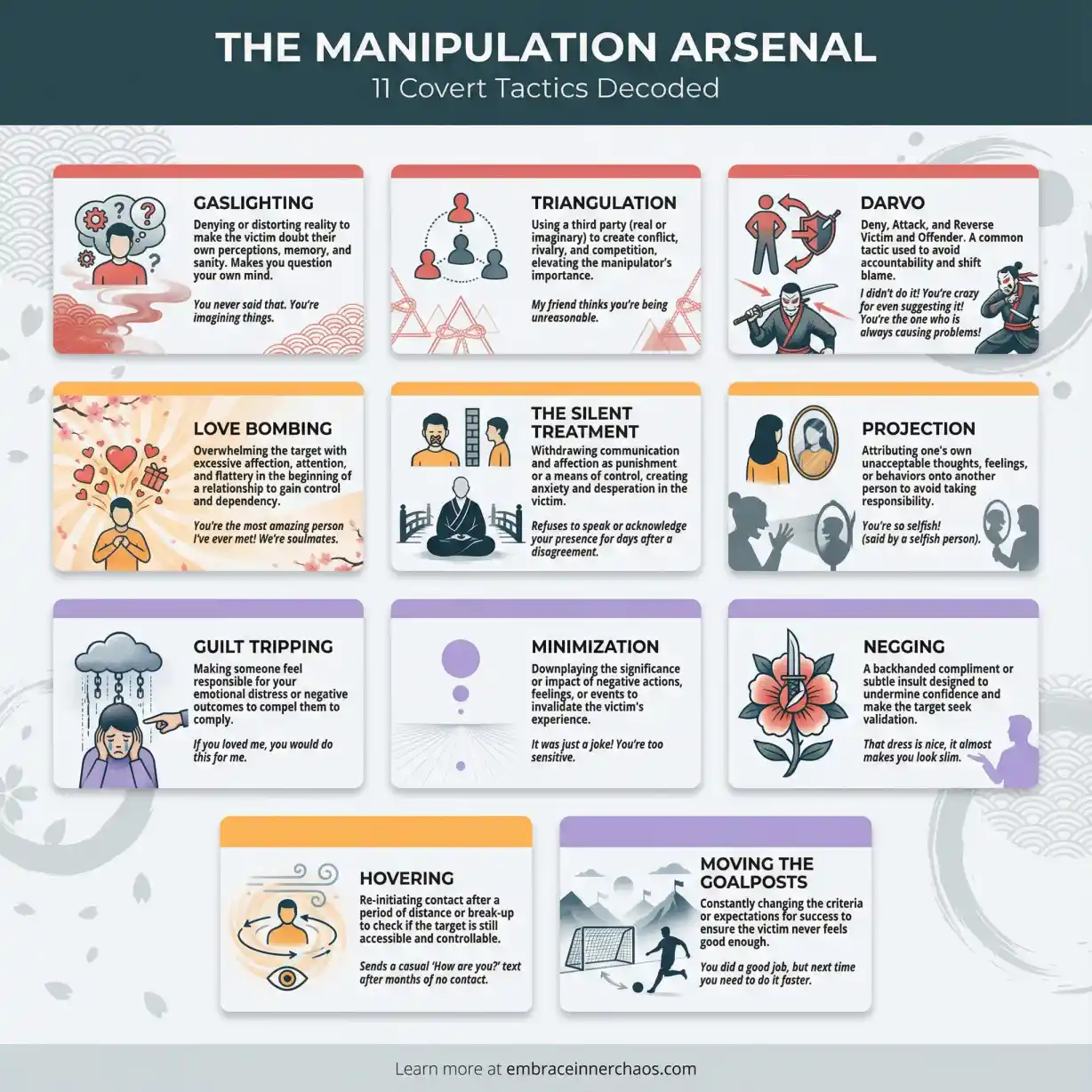
How Does A Covert Narcissist Sister Manipulate You?

Gaslighting: Reality Distortion

Gaslighting distorts your perception through phrases like: “That never happened.” “You’re remembering wrong.” “You’re being dramatic.” Over time, you stop trusting yourself and start asking others to verify basic facts.

“Gaslighting is an insidious form of emotional abuse that makes you question your own reality, memories, and perceptions.”
Dr. Robin Stern, author of The Gaslight Effect
To Counter Gaslighting:
  • Take breaks when confusion sets in
  • Use clear, direct language
  • Document what happens with dates and exact quotes
  • Set firm boundaries
  • Seek validation from trusted people outside the family

Triangulation: Divide and Conquer

She tells Mom you’re “abandoning the family.” She tells your brother you’re “being dramatic.” She tells you Mom is “worried about you.” None of it’s true. But everyone’s confused, and she’s the calm one in the middle. Learning to recognize covert narcissist family triangulation signs is essential for breaking this cycle.

This isolates you from potential support. You find yourself defending against accusations from conversations you weren’t part of, while she positions herself as the reasonable mediator.

Guilt-Tripping: Emotional Leverage

“After everything I’ve done for you…” “I guess family doesn’t matter to you.” Guilt-tripping exploits your empathy to override your boundaries and needs. Covert narcissists keep you feeling guilty because guilt is their most reliable control mechanism.

The Full Manipulation Arsenal
TacticWhat It Looks LikePsychological Impact
Gaslighting“That never happened” / “You’re too sensitive”Self-doubt, reality confusion
TriangulationDifferent stories to different family membersIsolation, damaged relationships
Silent treatmentIgnoring you for days/weeks as punishmentAnxiety, hypervigilance
DARVODeny, Attack, Reverse Victim and OffenderMakes you question if YOU’RE the abuser
Guilt-tripping“After everything I’ve done…”People-pleasing, approval-seeking
Love bombingSudden affection after coldnessCognitive dissonance, hope cycling
ProjectionAccusing you of HER behaviorsConfusion, self-blame
Passive-aggressionBackhanded compliments, deliberate inefficiencyFrustration, walking on eggshells
Victim playingPerformative suffering, martyrdomGuilt, caretaking exhaustion
CompetitionBelittling your achievementsDiminished self-worth
Sardonic “jokes”Insults with plausible deniabilityShame, self-consciousness

Why Does Your Family Believe Your Covert Narcissist Sister Over You?

Enabling behavior stems from the narcissistic family system she’s built over years. Flying monkeys do her bidding, often without knowing it. Enablers minimize her harm with: “She didn’t mean it,” “You’re too sensitive,” or “That’s just how she is.”

From working with survivors, I’ve learned that managing flying monkeys requires a completely different strategy than managing the narcissist. You can’t reason with people who’ve already accepted her version of reality. Research shows how narcissism can lead to sibling estrangement when these dynamics remain unaddressed.

“In narcissistic family systems, roles become fixed. The scapegoat absorbs blame; the golden child absorbs praise. These roles serve the narcissist’s needs, not the children’s wellbeing.”
Dr. Karyl McBride, author of Will I Ever Be Good Enough?

Identifying Enablers

They defend her regardless of evidence, pressure you to “keep the peace,” dismiss your feelings, blame you for the fractured relationship, and relay information between you.

Managing Flying Monkeys

Create strict information boundaries. Share nothing personal that could reach your sister. Respond to pressure with: “I’ve made my decision. I’m not discussing this.” Refuse to debate your reality. Seek validation from therapists familiar with narcissistic family dynamics.

Family Pattern Impact & Recovery
Family PatternImpact On YouRecovery Strategy
ScapegoatingChronic self-doubt, feeling flawedRebuild self-concept through therapy
TriangulationIsolation, damaged relationshipsBuild external support network
Gaslighting by familyReality confusionDocument everything for clarity
Flying monkeysContinued harassmentBlock information channels

Understanding the golden child vs the scapegoat roles in narcissistic families helps you recognize the systemic nature of the abuse you’ve experienced.

Detachment Techniques

You can learn to detach from your sister’s negative behavior. Detachment does not mean you stop caring. It means you protect your feelings. You can limit contact or keep conversations short. You can also avoid sharing personal details. This helps you stay calm and less affected by her words.

Ways To Detach
  • Limit time spent together. Set clear boundaries on duration of interactions.
  • Keep topics neutral. Stick to weather, sports, surface-level subjects.
  • Do not react to hurtful comments. Gray rock her provocations.

How Do You Set Boundaries With A Covert Narcissist Sister?

Start at the lowest effective level and escalate only when lower strategies fail. This isn’t about being “nice.” It’s about using minimum necessary force while preserving your options. Understanding how a narcissistic sibling can affect your personality helps you recognize what you’re protecting.

1: Gray Rock Method (Start Here)

Why start here: No confrontation, no announcements, no family drama. Implement right away and invisibly.

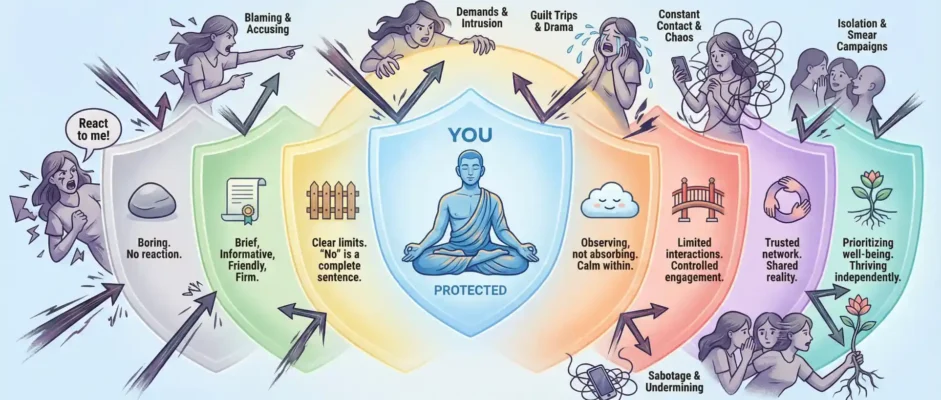
The gray rock method makes you emotionally uninteresting. Covert narcissists feed on reactions. Your anger, tears, frustration. Become boring. Give one-word answers. Show no emotional reaction, no highs or lows. Keep topics surface-level. Respond with delays when possible.

“The gray rock method helps you stay away from people who cause stress. It works well but should not be used all the time.”
Minkyung Chung, MS, LMHC, Talkspace therapist

When it works: She wants reactions. Gray rock starves her of supply, and she eventually seeks more reactive targets.

When to escalate: After 2-3 months of consistent gray rock, if your anxiety hasn’t decreased, or if she escalates tactics, move to stronger boundaries.

2: Information Diet

Pair gray rock with an information diet. She receives only basic, factual information. Nothing emotional, personal, or useful for manipulation.

When she asks about your life: “Work is fine.” “Nothing new.” “Same old.” When she probes deeper: “Not much to report.” Then change the subject or excuse yourself.

The goal: eliminate ammunition she can use against you in triangulation, guilt-tripping, or future manipulation.

3: Firm Boundaries With Consequences

Why this level: Gray rock works when she wants reactions. But some narcissists want specific outcomes. Your time, resources, compliance. Boundaries address this.

“Boundaries are not about controlling others. They’re about controlling your own exposure to harmful behaviors. With manipulative people, boundaries protect you; they don’t change them.”
Dr. Nedra Glover Tawwab, therapist and author of Set Boundaries, Find Peace

In my experience coaching survivors, the key isn’t explaining. It’s enforcing without discussion. Every justification becomes ammunition. When she engages in covert narcissist boundary violations, consequences must follow immediately.

4: Avoid JADE

JADE stands for Justifying, Arguing, Defending, Explaining. Every word you use to justify your boundary becomes ammunition she’ll use against you. State your limit once. Don’t elaborate. Don’t negotiate.

5: The Broken Record Technique

Calmly repeat your limit without elaboration, no matter how she responds:

  • “I understand you want me there, but I’m not available.”
  • “I hear you, but my answer hasn’t changed.”
  • “That doesn’t work for me.”

She may escalate, guilt-trip, or rage. Your response stays the same. Eventually, she learns that pushing doesn’t change your answer.

6: Boundary Scripts That Work

Learning how to set boundaries with narcissists requires practice and preparation.

Boundary Scripts
SituationScript
Guilt-tripping“I understand you’re disappointed. My decision stands.”
Demanding explanations“I’m not available to discuss this further.”
Triangulation“I’ll speak to [person] directly. I won’t respond to secondhand messages.”
Victim playing“I hear that you’re upset. I’m still maintaining this boundary.”

What To Expect After Setting Boundaries

Expect escalation. This proves boundaries are working:

Extinction Bursts
  • Narcissistic rage: Explosive anger at being denied control
  • Hoovering: Sudden sweetness to pull you back
  • Love bombing: Temporary affection and gifts
  • Smear campaigns: Telling family you’ve “changed” or are “being cruel”
  • Intensified victim playing: Telling everyone how much you’ve “hurt” her

Stay firm. These are extinction bursts. Intensified attempts before she accepts the new reality.

7: Documentation System

Keep a written record of incidents. This isn’t about building a legal case. It’s about protecting your sanity when she rewrites history.

What to document:

  • Date and time of the incident
  • Exact quotes when possible
  • Who was present
  • Your emotional state before and after
  • Any witnesses who can verify

Where to keep it:

  • A private journal she can’t access
  • Password-protected notes on your phone
  • Email drafts to yourself (timestamped)
  • Voice memos right after incidents

Why it matters: Gaslighting works because you start doubting your memory. Written records anchor you to reality. When she says “I never said that,” you can check your notes. You don’t need to show her. You just need to know.

Review your documentation monthly. Patterns become obvious when you see six months of incidents on paper. This clarity helps you make decisions about escalating to low or no contact.

Boundary Violations Vs Enforcement With A Covert Narcissistic Sister by Som Dutt From Embrace Inner Chaos class=
Boundary Violations Vs Enforcement With A Covert Narcissistic Sister

What Are The Different Types Of Boundaries With A Covert Narcissist Sister?

Different boundary types protect different aspects of your life. Most survivors need all four. Learning how to deal with a narcissistic family member starts with understanding which boundaries you need most.

Four Types of Boundaries
TypeProtection LevelWhat It ProtectsExample
EmotionalHighYour feelings, mental energy, self-worth“I’m not discussing my marriage with you.”
PhysicalModerateYour body, personal space, home“I need you to call before coming over.”
Time-basedHighYour schedule, energy reserves“I’m leaving at 3pm regardless of when dinner starts.”
InformationVery HighPersonal details she could weaponize“I’m not sharing details about my job situation.”

How Do You Survive Family Gatherings With A Covert Narcissist Sister?

Family gatherings are highest risk for survivors. Toxic dynamics get worse when the entire system assembles, and your sister has a captive audience for her performance.

Exit Signal Protocols

Pre-arranged signals with your ally let you escape without explanation or drama.

Physical Signals
  • Touching your ear = “Rescue me from this conversation”
  • Rubbing your neck = “She’s escalating, stay close”
  • Checking your phone = “We leave in 10 minutes”
  • Saying a code phrase like “I’m getting hungry” = “Get me out now”

Before The Gathering: Preparation Is Protection

+
  • Set a firm time limit before you arrive. Decide exactly when you’re leaving and tell someone who’ll hold you accountable.
  • Arrange independent transportation. Never depend on others for your exit. Uber, your own car, a friend on standby.
  • Script responses to predictable provocations. You know her patterns. Write out 2-3 responses to her most likely attacks.
  • Bring a trusted ally and establish signals. This person understands the dynamics and watches for your distress.
  • Lower your expectations to zero. She won’t suddenly change. Your goal isn’t a good time. It’s surviving with your boundaries intact.
  • Eat before arriving. Low blood sugar makes emotional regulation harder.
  • Plan your positioning. Know where you’ll sit, who you’ll talk to, what topics are safe.
  • Have a cover story for leaving early. “Early morning tomorrow” or “not feeling well” lets you exit without drama.

During The Gathering: Strategic Navigation

+
  • Position yourself physically near supportive people. Stay close to family members who respect you or your ally.
  • Apply gray rock if direct engagement is unavoidable. One-word answers. No emotional reactions. Boring.
  • Take strategic breaks. Step outside for air. Help in the kitchen. Use the bathroom. Every 30-45 minutes, remove yourself to reset.
  • Avoid alcohol. It lowers defenses and makes emotional reactions more likely.
  • Watch for triangulation attempts. If she says “Mom was just telling me she’s worried about you,” don’t engage. “I’ll talk to Mom directly” ends the triangle.
  • Don’t take the bait. She may make provocative comments designed to get a reaction. Smile blandly and change topics.
  • Document mentally or physically. If something significant happens, note it discreetly on your phone.
  • Check in with your ally. Brief eye contact, a quick word in passing — maintain your support connection.
  • Honor your exit time. When your predetermined departure time arrives, leave. No negotiations, no “just a few more minutes.”

After The Gathering: Recovery Protocol

+
  • Debrief with your ally right away. Talk through what happened while it’s fresh. Their outside perspective helps counter any gaslighting.
  • Practice self-compassion regardless of how it went. If you held your boundaries, celebrate. If you slipped, analyze without self-attack.
  • Document any incidents. Write down concerning statements or behaviors with dates and context.
  • Allow yourself recovery time. Don’t schedule demanding activities the next day. Your nervous system needs to decompress.
  • Engage in active self-care. Exercise, nature, creative activities, time with supportive people.
  • Process any guilt. She may have said things designed to make you feel guilty. Remind yourself: boundaries aren’t cruelty.
  • Evaluate the cost-benefit. After each event, honestly assess: Was attending worth it? This data informs future decisions.
  • Adjust strategies for next time. What worked? What didn’t? Refine your approach.

Why Strategic Allies Matter

A trusted ally at family gatherings helps you:

  • Maintain boundaries under pressure
  • Provide reality checks when you start doubting yourself
  • Prevent you from getting drawn into arguments
  • Execute your exit strategy when needed
  • Process the experience afterward

Choose someone who understands narcissistic dynamics and won’t minimize your experience.

How Do You Implement Low Contact With A Covert Narcissist Sister?

When gray rock and boundaries aren’t enough, low contact reduces exposure while maintaining minimal family connection.

Low Contact Means
  • Communication limited to necessary topics only — logistics, emergencies, necessary family coordination
  • Response windows like “I check messages on Sundays” create predictable distance
  • Email instead of phone creates documentation and reduces emotional intensity
  • Brief, transactional interactions with no personal sharing
  • Attendance only at must-attend family events, always with strict time limits

Low contact is appropriate when:

  • Boundary violations continue despite consistent enforcement
  • Maintaining regular contact requires more energy than it’s worth
  • You need time and space to heal while not ready for full no contact
  • Geographic or family circumstances make no contact impractical

When to escalate to no contact:

  • Even minimal contact leaves you emotionally exhausted
  • She weaponizes every interaction regardless of frequency
  • Anxiety and depression persist despite reduced exposure
  • The relationship provides zero positive value

How Do You Implement No Contact With A Covert Narcissist Sister?

No contact is the highest level of protection. It’s not giving up. It’s choosing your mental health over a relationship that destroys it.

When No Contact Becomes Necessary

  • Every interaction leaves you emotionally exhausted for days
  • Your mental health deteriorates despite all other strategies
  • Physical symptoms appear: insomnia, headaches, digestive issues, chronic tension
  • You’ve lost your sense of self in the relationship
  • Walking on eggshells has become your baseline state
“When a relationship consistently harms your mental health and shows no capacity for change, removing yourself is not abandonment. It’s survival.”
Dr. Sherrie Campbell, author of Adult Survivors of Toxic Family Members

Trust your body. Chronic stress, anxiety, or dread before any contact indicates the relationship costs too much.

Step-By-Step No Contact Implementation

Block all communication channels. Phone, text, email, social media. All of them. Partial blocks create loopholes she’ll exploit.

Change passwords. Any accounts she might access, including shared family accounts.

Refuse third-party contact attempts. Flying monkeys may deliver messages, gifts, or “urgent” requests to contact her. Politely decline: “Please don’t pass messages between us.”

Prepare one statement for family. Keep it simple and final: “I’ve decided I need space from [sister] for my wellbeing. I’m not discussing this or debating it.” Repeat as needed.

Don’t engage in justifications. You don’t owe explanations. Explaining opens debates. Debates exhaust you and change nothing.

Expect extinction bursts. When narcissistic supply is cut off, she may dramatically escalate. More flying monkeys, fake emergencies, showing up uninvited, smear campaigns. These bursts eventually fade when she realizes they don’t work.

Handling Family Pressure After No Contact

Family members may pressure you to reconcile. Some responses:

  • “I understand this is hard for you. My decision is final.”
  • “I’m not available to discuss my relationship with sister.”
  • “I appreciate your concern. Please respect my boundary.”
  • “I won’t be attending events where she’s present. Let me know about other gatherings.”

Those who continue pressuring after clear boundaries reveal themselves as enablers. Those who respect your decision, even without understanding, demonstrate relationships worth maintaining.

How Do You Cope With Grief After Cutting Contact With A Covert Narcissist Sister?

Cutting contact starts a grief process. Not for who she is, but for who you wished she could be. You’re mourning the sibling relationship you deserved but never had. If you’re unsure whether your situation warrants these measures, taking the is my sister a narcissist or sociopath test can provide additional clarity.

This grief is real. You may feel guilt, sadness, relief, anger, or a complex mix at once. Some days you’ll feel certain you made the right choice. Other days you’ll question everything.

“Recovery happens in the context of relationships. Isolation is the enemy of healing; connection is its foundation.”
Dr. Judith Herman, trauma research pioneer

Build support outside the toxic family system. Chosen family — friends, partners, mentors who respect your boundaries and validate your reality — becomes critical during this period. Learning about narcissistic sibling relationships can help normalize your experience and validate your decision.

Your Path Forward

Dealing with a toxic narcissistic sister means accepting hard truths: she likely won’t change, some family members won’t believe you, and recovery requires grieving the sibling relationship you deserved but never received.

What Recovery Looks Like

The fog lifts. Slowly at first, then all at once. You stop seeing yourself through her distorted lens. The anxiety before family gatherings fades. The voice that sounds like her criticism grows quieter until one day you realize it’s been weeks since you heard it.

Your nervous system learns safety. You stop bracing for attacks that aren’t coming. Sleep comes easier. Laughter feels genuine again.

And the biggest shift: you meet yourself again. Beneath the self-doubt she planted, beneath the hypervigilance she required, there’s a person who was always worthy of love, respect, and peace.

You didn’t cause her covert narcissism. So, you can’t cure it. You can only choose how much of your remaining life it’s allowed to touch.

The choice is hard. The grief is real. And the freedom on the other side is worth every step.

Frequently Asked Questions

Does Confronting A Covert Narcissist Sister Work?

+

Rarely. She’ll respond with DARVO, blame-shifting, and intensified victim playing. Most common mistake: seeking closure from the narcissist. Create your own closure through understanding NPD. Not through her validation.

How Long Does Recovery Take?

+

Timelines vary based on abuse duration, support quality, and therapy access. Most survivors report significant improvement within 1-2 years. The goal isn’t “getting over it.” It’s building a life where her impact gets smaller over time.

How Do You Protect Children From A Narcissistic Aunt?

+

Limit unsupervised interactions. Monitor for triangulation or favoritism. Teach age-appropriate boundary concepts. If she won’t respect limits, no contact becomes necessary.

Why Do You Miss Her Despite The Abuse?

+

Trauma bonding creates genuine attachment despite harm. What you’re feeling isn’t weakness. It’s neurochemistry. This grief confirms you’re human. It doesn’t mean no contact was wrong.

How Do You Explain No Contact To Family?

+

You don’t owe explanations. Simply: “I’ve made this decision for my wellbeing. I’m not discussing it.” Those who pressure you reveal themselves as enablers.

Could My Sister-In-Law Also Be A Narcissist?

+

Narcissistic patterns often extend to in-laws. If you’re noticing similar manipulation tactics from your sister-in-law, take our is my sister-in-law a narcissist test to assess the situation.