


A passive aggressive covert narcissist sister says something that sounds like support and leaves you feeling hollow. You replay the conversation. The words were fine. The tone was fine. But something landed wrong and you cannot explain it to anyone, not even yourself.
You have spent years wondering if you are the jealous one, the difficult one. You are not imagining it. In my seven years coaching over 1,400 survivors of covert narcissistic abuse, this is the story I hear most from sisters.
Psychologist Paul Wink’s foundational 1991 research identified two distinct narcissism subtypes: grandiose and vulnerable. The vulnerable form runs on indirect hostility, not open aggression. And your sister has been practicing it since childhood.
TL;DR
She wounds with plausible deniability.
A passive aggressive covert narcissist sister uses backhanded compliments, silent treatment, and guilt-tripping that sound caring but register as attacks in your body. You cannot prove it because the words seem fine.
Family is her operating system.
She triangulates parents, gaslights shared childhood memories, and plays victim to control narratives across the family.
Fragile self-esteem drives the cruelty.
Research (2015, n=653) confirmed the pathway: covert narcissism produces internalized shame, fuels anger rumination, drives relational aggression sideways.
Your sibling bond absorbs the cost.
One-sided emotional labor creates self-doubt, depression, and slow estrangement you cannot explain.
The confusion is engineered.
At family events she performs public affection while delivering private digs. 74% of abuse victims report this gaslighting pattern (NDVH).
How Does a Passive Aggressive Covert Narcissist Sister Operate Day-to-Day?
The confusion is the point. A passive aggressive covert narcissist sister works through what researchers call ambiguous communication: saying one thing while implying another, creating a double bind where confronting her makes you look irrational because her words seemed innocent enough (Hopwood & Wright, 2012).
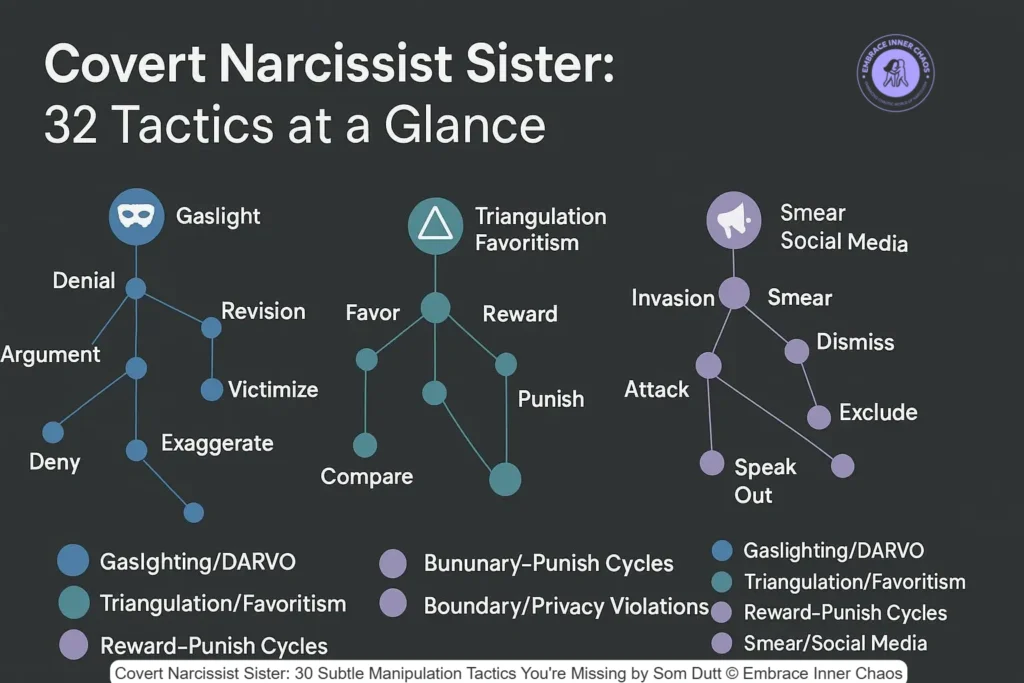
Survivors describe three tactics that cycle through daily interactions.
The Backhanded Compliment Cycle
You got the promotion. She said, “That’s great, but have you really thought about the stress? I just worry about you.” Congratulation and undermining in one breath. Plausible deniability baked into every word. Call it out, and she was “just being concerned.” Stay quiet, and the message lands right where she aimed it.
She has a version of this for every area of your life:
“You look so much better today.” Translation: you usually don’t.
“That’s a bold choice for your wedding dress.” Translation: I would never wear that.
“I admire how you don’t worry about what people think of your parenting.” Translation: everyone is judging you.
“I could never be as relaxed about housekeeping as you are.” Translation: your house is a mess.
These create cognitive dissonance. The words sound supportive. Your body registers the attack. And when you try to explain why you are upset, you sound paranoid. That is the point. Paulette Wink’s foundational 1991 research in the Journal of Personality and Social Psychology identified this profile as Vulnerability-Sensitivity narcissism: individuals marked by introversion, defensiveness, and anxiety who still carry core narcissistic traits like conceit, self-indulgence, and disregard of others.
Green and Charles (2020) documented this in a study of 436 relatives published in BMC Psychiatry: covert expressions of abuse included passive aggressive behaviors, often triggered when the narcissist perceived a challenge to their status. Your promotion was not your achievement to her. To her, it was a threat.
Silent Treatment as Weaponized Withdrawal
The silent treatment from a covert narcissist sister is not needing space. It is punishment. And it works because you care enough to chase her. This kind of covert narcissist sister abuse is invisible to everyone except the person on the receiving end.
She does not storm out or announce her anger. She goes cold. Distant. Unreachable. The whole family re-orients around her mood without her making a single demand.
You reread her texts looking for clues. Monitor her tone on calls. Walk on eggshells before she has said a word. Cain, Pincus, and Ansell (2008) described this in the Clinical Psychology Review as the hallmark of vulnerable narcissism: diffidence that shows up as indirect aggression.
She retreats. You scramble. The power stays with her.
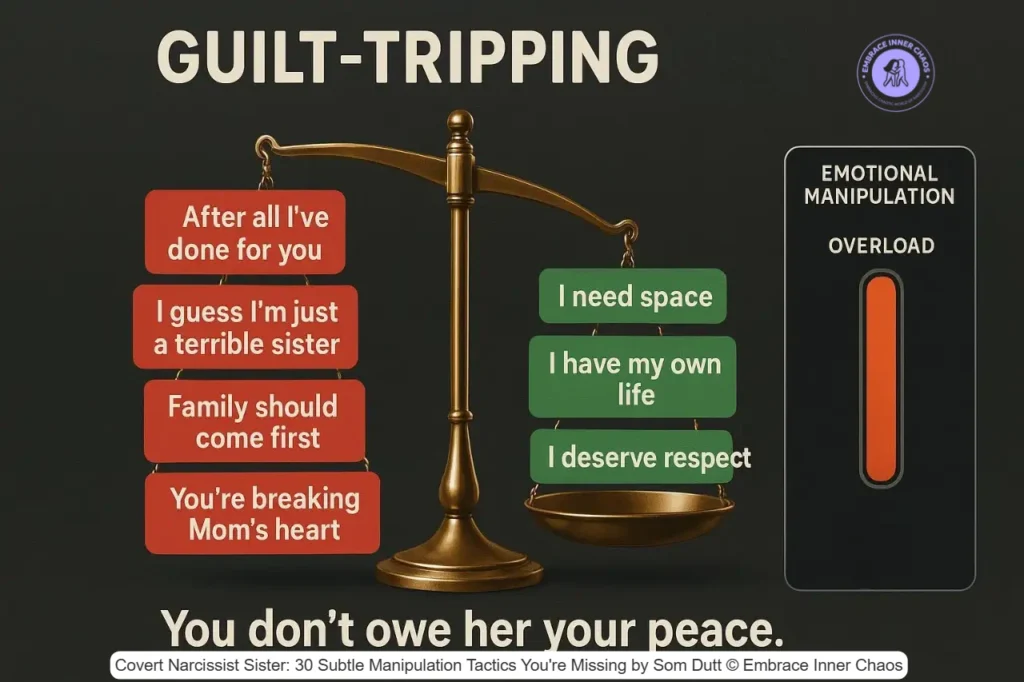
Guilt-Tripping Disguised as Concern
“I guess some people are just too busy for family.” She does not say your name. No accusation either. But you know who she means. The guilt lands before you can even figure out what happened.
“After everything I’ve done for you as your sister” is not a statement of love. It is a ledger. Entitlement dressed up as martyrdom. Hopwood and Wright (2012) identified this as one of three core passive aggressive manifestations: intentional inefficiency, sullenness, and deliberate forgetfulness of agreements. These patterns almost always involve covert narcissists’ boundary violations disguised as expressions of care.
Your sister may cycle through all three in a single holiday weekend.
If this rings true, you are not a bad sister for seeing it. She has been practicing since you were children. The tactics just grew more sophisticated as you both got older.
How Does a Passive Aggressive Covert Narcissist Sister Weaponize Family Dynamics?
Family systems give this behavior a ready-made cover. Shared history, shared parents, shared Thanksgivings. A passive aggressive covert narcissist sister does not need to control you head-on. She controls the narrative moving between you and everyone else.
Triangulating Parents and Siblings
She tells your mother one version of events. Tells you another. Then she steps into the role of reasonable mediator who just wants peace.
“Mom agrees with me.” “Dad thinks you’re being difficult.” “Everyone in the family thinks you’re overreacting.”
You hear these phrases, and now you are defending yourself against an invisible jury she assembled without your knowledge.
This did not start in adulthood. A 2022 study by Ferencz and colleagues published in Current Psychology found that parental partiality toward one sibling correlated with narcissism across three separate studies, while sibling conflict predicted Machiavellianism and parental rejection combined with overprotection predicted vulnerable narcissism.
She figured out which parent to approach with which story a long time ago. She picked up that controlling information between family members builds power without a fight. By the time you catch on, she is already the peacemaker in everyone’s eyes and you are the one causing drama.
Gaslighting Your Shared History
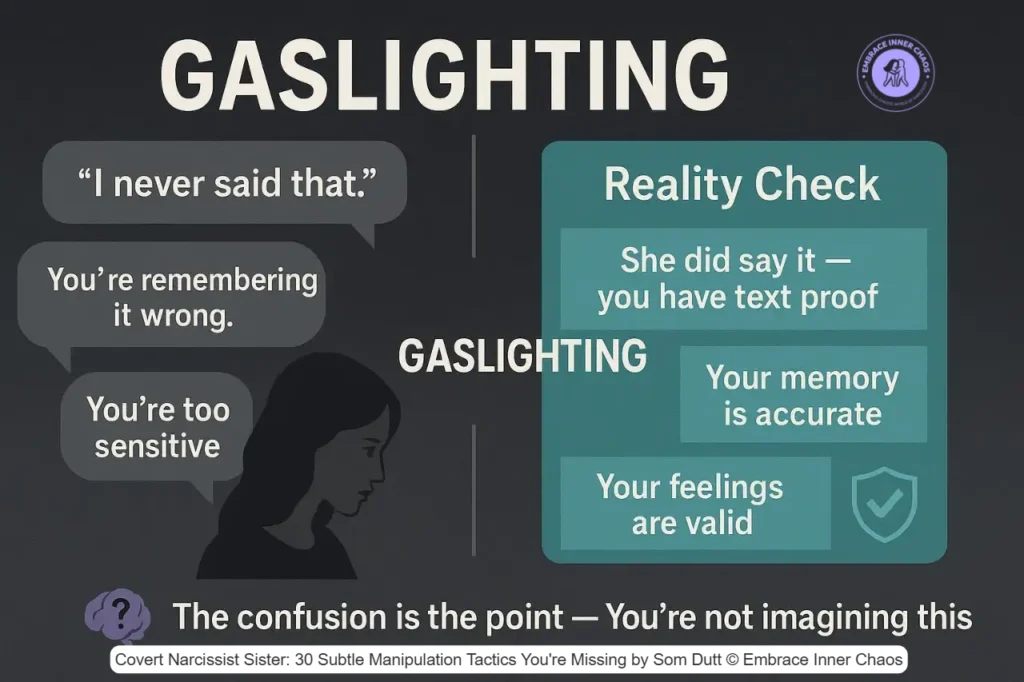
“That never happened.” “You’re remembering it wrong.” “I never said that.”
Gaslighting from a covert narcissist sister hits different than other relationships because she was there. She shares your childhood. She has access to decades of memories, and she rewrites them when they threaten her version of events.
“We were so close growing up,” she tells relatives at Thanksgiving, while you remember years of quiet cruelty she now denies ever happened.
The National Domestic Violence Hotline found that 74% of abuse victims experienced gaslighting. Merriam-Webster named it 2022’s Word of the Year after lookups went up 1,740%. You are not the only person who needed a word for this.
What makes sister gaslighting so damaging is the idealization-devaluation cycle underneath it. One month, she is your best friend. Sharing secrets. Making plans. Then something turns. The cold sets in. The passive aggressive digs return. You scramble trying to figure out what you did wrong. Day, Townsend, and Grenyer’s 2022 research in Personality and Mental Health studied 436 relatives of individuals with pathological narcissism and found that devaluation and vulnerability themes appeared in 81% of descriptions, while charm occurred mainly in public or initial stages.
You keep trying to get back to the “good” sister. But that version was never real. It was the setup for what came after.
Your memories are valid, even when she rewrites them.
The Victim Identity Mask
Her suffering is always more legitimate than yours. Her struggles always bigger. You had a difficult week? She had a worse month. You are exhausted? She is exhausted and nobody appreciates her.
Researchers call this competitive victimhood (Ochojska & Pasternak, 2024), and it does several things at once: deflects accountability, draws sympathy, and shuts down anyone who might question her behavior. This is the hallmark of a covert narcissist’s victim mentality: suffering performed loudly enough to silence everyone else.
The NESARC Wave 2 study (Stinson et al., 2008, n=34,653) found NPD prevalence at 6.2% in the U.S., with women at 4.8% compared to men at 7.7%. That gap is not because fewer women are narcissistic. Frontiers in Psychology (2023) confirmed that vulnerable narcissism is more prevalent in females but under-appreciated in diagnostic frameworks because it looks like hurt feelings, not entitlement. Gabay, Hameiri, Rubel-Lifschitz, and Nadler (2020) established in Personality and Individual Differences that the tendency for interpersonal victimhood is a stable personality trait with four dimensions: need for recognition, moral elitism, lack of empathy, and rumination, and that it predicts expectations of hurtful behavior even in ambiguous situations.
Your sister’s victimhood does not disqualify her from this pattern. It is the pattern.
Why Does a Passive Aggressive Covert Narcissist Sister Choose Indirect Tactics?
She avoids direct conflict because she cannot survive it. Not on an emotional level. Understanding the difference between an overt and covert narcissist sister matters here: the overt version fights in the open; the covert version cannot afford to.
Her self-esteem is fragile, tied to her polished identity as the good sister, the devoted daughter. Open conflict risks exposure. If she argues in front of others, someone might catch the cruelty behind the performance. If she loses, her family image falls apart.
So she wages what researchers call the “dove strategy” (Kroencke et al., 2023): submissive when people are watching, aggressive behind closed doors, always through channels she can deny.
A 2015 study (n=653) mapped the psychological pathway: covert narcissism produces internalized shame, which fuels anger rumination, which drives relational aggression. She feels shame. She ruminates. Then she acts it out sideways through passive aggressive tactics she can later reframe as “just trying to help.” Krizan and Johar’s research in the Journal of Personality confirmed that vulnerable narcissism is strongly linked to dispositional envy and indirect hostility: individuals with narcissistic vulnerability internalize perceived slights and respond through covert retaliation rather than open confrontation.
This started in childhood. She figured out early that going after you in the open risked parental disapproval, but going at you sideways, the disappointed sigh, the under-her-breath comment to Mom, the “accidental” spilling of your secret, that cost her nothing.
By adulthood, the strategy is second nature. She chose indirect cruelty not because she was wired that way from birth, but because open conflict would cost her the one thing she cannot lose: the family’s perception of her.
Does this explain why you always felt like the argument was happening underwater? You were not wrong. She built it that way.
What Does a Passive Aggressive Covert Narcissist Sister Do to Sibling Bonds?
The damage builds up over years. There is no single incident you can point to, no dramatic fight, no breaking point. Just years of one-sided emotional labor that wears down who you are in the relationship.
You invest. She drains. You call, check in, adjust, accommodate. She takes. Every supportive gesture you offer turns into a future control credit on her invisible ledger. The relationship becomes narcissistic supply extraction dressed up as sisterhood.
Gu and Hyun (2021, n=316) found covert narcissism associated with depression through shame-focused coping: attack-self and withdrawal. Survivors know what the research does not spell out: the sibling on the receiving end picks up these exact patterns.
You doubt your perceptions. Question whether you are the selfish one. Apologize for having needs. Rehearse conversations before you have them and track her tone changes like a seismograph. Learning how to deal with a covert narcissistic sister starts with recognizing that these responses are not flaws in your character but adaptations to years of invisible manipulation.
Pressman and Pressman described this in The Narcissistic Family: “The typical adult from a narcissistic family is filled with unacknowledged anger, feels like a hollow person, feels inadequate and defective.”
The estrangement happens without anyone slamming a door. A slow, quiet pullback from a relationship that costs more than it gives.
And the guilt of stepping away feels worse than staying, because family, friends, even your own children keep reminding you: “But she’s your sister.”
You are mourning a sister relationship that never existed, and nobody around you gets why that grief sits so heavy.
You are not inadequate. You have been shaped by decades of invisible manipulation from someone who was supposed to be safe.
More Articles You Might Find Helpful:
→ 31 Covert Narcissist Sister Manipulation Tactics You Might Be Missing
→ Why Covert Narcissists Target Empaths And Highly Sensitive People
→ Covert Narcissists & Boundary Violations: Recognizing Subtle Patterns
→ Covert Narcissists & Victim Mentality: How They Use It To Their Advantage
→ Covert Narcissist Financial Abuse: A Comprehensive Guide
→ When Helping Hurts: The Covert Narcissist’s False Altruism
How Do You Recognize a Passive Aggressive Covert Narcissist Sister at Family Events?
The holiday dinner. She hugs you in front of your parents. Twenty minutes later, in the kitchen where nobody else can hear: “You look tired. Is everything okay with you and [your partner]?”
The concern sounds real. The insinuation lands right where she aimed it.
You leave family gatherings feeling wrong but cannot name what happened. That confusion? It is not a side effect. It is the whole point. If you are starting to see these patterns, learning to identify the signs of a covert narcissistic sister can help you trust what your body already knows.
| What Others See | What You Experience |
|---|---|
| Warm, loving sister greeting everyone | Subtle digs delivered when no one else is within earshot |
| “So happy for you!” about your news | Immediate pivot to her own struggles or a backhanded qualifier |
| Devoted daughter caring for aging parents | Caregiving martyrdom performed for maximum visibility |
| Gushing “best sisters” social media post | She did not call or text you on your birthday |
| Peacemaker smoothing over family fights | Instigator who started the conflict, then stepped in to fix it |
She shows up late enough to grab attention. Parks herself near your parents. Posts the family photo on social media with a caption about sisterly love while you are still sitting with the comment she made about your parenting when no one else was around.
Your wedding becomes about her dress, her toast, her feelings about not being asked to do more. Your pregnancy announcement gets overshadowed by her sudden health crisis. Your children’s milestones get stacked against hers.
And if you said any of this out loud, you would come off as the difficult one (Frontiers in Behavioral Neuroscience, 2024).
You are not the difficult one. You are the one paying attention. And it took this long to see it because she has been running this performance your entire life.
You Were Not Imagining It
You were not jealous. You were not “too sensitive.” What you experienced has a name, and research documents the exact patterns you lived with. It took years to see because it was designed to take years.
That is not a failure of perception. It is a feature of covert manipulation. You are not a bad sister for seeing it. You are the first one who did.
FAQs
What Are The Signs Of A Passive Aggressive Covert Narcissist Sister?
Backhanded compliments, silent treatment as punishment, guilt-tripping disguised as concern, triangulating family members, gaslighting shared memories, and competitive victimhood. She sounds supportive in public but leaves you feeling confused and drained in private.
How Does A Passive Aggressive Covert Narcissist Sister Differ From Normal Sibling Rivalry?
Sibling rivalry is situational and balanced. A passive aggressive covert narcissist sister runs a consistent pattern of manipulation, lacks empathy, rewrites shared history, and weaponizes family dynamics for control over years or decades.
Why Does A Passive Aggressive Covert Narcissist Sister Avoid Direct Confrontation?
Her self-esteem depends on being seen as the “good sister.” Open conflict risks exposing the cruelty behind her performance. Research calls this the “dove strategy”: submissive when watched, aggressive behind closed doors (Kroencke et al., 2023).
Can A Passive Aggressive Covert Narcissist Sister Ever Change Her Behavior?
NPD is deeply rooted and resistant to change. Most covert narcissists do not acknowledge the harm they cause. Protect yourself through firm boundaries rather than waiting for change that clinical research shows rarely comes without intensive, long-term therapy.
How Does A Passive Aggressive Covert Narcissist Sister Use Gaslighting Against You?
She rewrites your shared childhood: “That never happened,” “You’re remembering it wrong.” Because she was there for those memories, her denials hit harder than gaslighting from a stranger. The NDVH found 74% of abuse victims experienced this tactic.
What Does The Silent Treatment From A Passive Aggressive Covert Narcissist Sister Actually Mean?
It is not needing space. It is punishment. She goes cold and unreachable until you chase her or give in. Cain, Pincus, and Ansell (2008) identified this as the hallmark of vulnerable narcissism: indirect aggression through withdrawal.
How Does A Passive Aggressive Covert Narcissist Sister Affect Your Mental Health Long-Term?
Gu and Hyun (2021) linked covert narcissism exposure to depression through shame-focused coping. Survivors report chronic self-doubt, anxiety, conflict avoidance, and difficulty trusting others. You rehearse conversations and track her moods like a seismograph.
Why Does No One Else In The Family See My Passive Aggressive Covert Narcissist Sister’s Behavior?
She performs warmth in public and delivers cruelty in private. Family members see the “loving sister” act because she triangulates information and controls the narrative. Frontiers in Psychology (2023) confirmed covert narcissism in women is under-recognized in clinical settings.
Is Going No Contact With A Passive Aggressive Covert Narcissist Sister The Only Option?
Not always. Low contact with firm boundaries works for some survivors. But if every interaction drains you and the relationship costs more than it gives, no contact may be necessary. A therapist trained in narcissistic abuse can help you decide.
How Do I Stop Feeling Guilty For Recognizing My Passive Aggressive Covert Narcissist Sister’s Behavior?
Guilt is the tool she built into the system. “But she’s your sister” keeps you locked in. Naming what happened is not betrayal. It is self-preservation after decades of invisible manipulation by someone who was supposed to be safe.