


You’ve watched the switch happen a hundred times. How do covert narcissists know when to hide their narcissism so well that you’re the only person who sees through it? That question has probably kept you up at night.
One second, they’re cold. Dismissive. Cutting you down with a tone no one else would catch. Then the front door opens. A friend walks in. And just like that, the kindness floods back into their voice, the smile returns, and they greet the newcomer like nothing happened.
You’re left standing there, gut knotted, wondering if you imagined the last ten minutes. You didn’t.
That switch is not random. It is not a mood swing. It runs on a specific internal mechanism, and after years of walking on eggshells around this, you deserve to know how it works and why it leaves you questioning your own sanity.
TL;DR
Shame Runs the Switch, Not Intelligence: Covert narcissists hide their narcissism because exposure triggers a shame response so severe it threatens their fragile false self. Research by Pincus and Dickinson links vulnerable narcissism to a shame-avoidance cycle that drives audience-dependent masking.
The Public-Private Split Is a Supply System: They perform kindness, humility, and concern when witnesses are present because that public persona is their narcissistic supply source. Private cruelty surfaces only when no one can hold them accountable.
Hypervigilance Acts as Social Radar: Covert narcissists read every room through a threat detection loop, not social skill. They scan for who could expose them, who provides supply, and who lacks the credibility to be believed. The persona switch happens in seconds.
The Mask Slips When Resources Run Out: Supply depletion, ego threat overload, and narcissistic collapse cause the mask to fail. Studies show vulnerability spikes produce interpersonal coldness, not openness. That sudden cold shift you’ve noticed is the narcissism surfacing without its cover.
They Know Enough to Switch But Not Enough to Stop: Covert narcissists demonstrate what researchers call recognition without responsibility. They can describe narcissistic traits with accuracy, yet shame blocks the accountability needed for change. The switching is deliberate enough to be tactical but automatic enough to feel instinctive.
How Covert Narcissists Use Shame to Decide When to Hide
Most people assume covert narcissists hide their behavior because they’re socially intelligent. That’s the wrong frame. They hide because the fear of being exposed feels like psychological annihilation.
Researchers Dickinson and Pincus documented in their 2003 interpersonal analysis that vulnerable narcissism and shame form a tightly bound cycle. The covert narcissist carries a fragile self-esteem propped up by a false self. That false self is not a choice they made one afternoon. It is the entire architecture holding their identity in place. Any crack in it triggers a wave of shame so overwhelming that the person will do almost anything to prevent it.
Here’s where covert narcissism splits from its grandiose counterpart. A 2017 study by Hart, Adams, and colleagues in Personality and Individual Differences found that vulnerable narcissists use both assertive and defensive self-presentation tactics at the same time. Grandiose narcissists project confidence and dominance outward. Covert narcissists do something far more disorienting: they project weakness, victimhood, and humility as a defensive shield while at the same time protecting a hidden sense of superiority from exposure. That dual operation is what makes them so hard to pin down.
“I’m just a private person.” “I don’t like drama.” These are phrases you’ve probably heard dozens of times. They sound reasonable. That’s the point. The shame driving the mask makes every tactic come wrapped in plausible deniability.
A client I worked with last year described it this way: her partner would spend twenty minutes tearing apart her parenting decisions in a calm, controlled voice. The moment her sister called, he’d pick up the phone and say, “Oh, we’re just having a quiet evening.” She told me she started to believe she’d exaggerated the conversation in her own head. She hadn’t. The hiding was just that precise.
That precision is not skill. It’s terror. The covert narcissist’s ego threat response activates the moment there’s any risk of being seen as the person they are behind closed doors. Shame avoidance drives the switch, and the switch is so fast it makes you doubt what you saw three seconds ago.
Why Covert Narcissists Act Differently When Witnesses Are Present
The public-private split is the single most disorienting experience survivors describe. And it is the core reason no one believes you.
Sociologist Erving Goffman’s work on impression management describes how people perform different versions of themselves depending on their audience. Most people adjust a little between their public and private selves. The covert narcissist? The gap is a canyon.
A 2026 systematic review published in Deviant Behavior documented what researchers call “contextual fluency” in individuals with narcissistic traits. These individuals display “audience-sensitive impression management” and “selective charm” that allows them to maintain social favor while causing real relational damage behind closed doors. Translation: they know who to perform for, and they adjust in real time.
That public persona is not a bonus feature. It is the supply source. Pity, admiration, the image of being humble and self-sacrificing. Every bit of that social performance feeds the covert narcissist’s need for narcissistic supply. The private cruelty is what happens when supply isn’t being watched. When no audience is present, there’s nothing to perform for, and the mask becomes unnecessary baggage.
“Ask anyone. They’ll tell you I’m a good person.” “Nobody else has a problem with me.” “You always twist things.” You’ve heard these lines because they serve a function. They remind you that the version of them everyone else sees is the “real” one. The version you see? You must be making that up.
I had a client whose mother would volunteer at the school, bake for neighbors, and show up at church with a warm smile every Sunday. She’d ask other parents about their kids with what looked like genuine concern. Performative empathy, down to the last detail. At home, she’d go days without speaking to my client after a perceived slight. The silence was the punishment. The public kindness was the alibi.
It works because covert narcissists don’t do anything outsiders can point to. There is no yelling. No scene. Just a tone shift you can’t record, a comment you can’t quote without sounding petty, and a withdrawal you can’t prove is intentional. That invisible abuse setup is what makes the public-private split so devastating. The performance IS the invisibility shield.

How Covert Narcissists Read the Room Before Choosing a Mask
The speed of the switch is the part that breaks you. One second they’re ice cold. A door opens. And they’re a different person. The shift is so smooth that you start to wonder if YOU are the problem.
That speed comes from hypervigilance. Not the kind trauma survivors experience, but a different brand. Pincus and Cain’s clinical model of narcissistic grandiosity and vulnerability documents that vulnerable narcissism involves a constant search for social cues that signal rejection, criticism, or exposure. The covert narcissist’s nervous system is running a continuous threat detection loop on every room they enter.
What Covert Narcissists Scan For Before Switching Personas
They’re not reading the room the way a socially attuned person would. They’re running a risk assessment. Three factors feed the switch:
Who is present. People who could damage their reputation trigger the mask. People who can’t expose them, like a partner or child with no outside credibility, get the unmasked version.
What’s at stake. If social consequences exist, the persona stays locked in. If no one will know, ego protection drops and the real pattern surfaces.
Who provides supply. People positioned to offer pity, admiration, or validation get the performance. People who’ve already been secured as supply sources get maintenance at best, contempt at worst.
This is not social intelligence. It is loss prevention. Hart and colleagues described self-presentation in narcissism as “tactical behavior designed to claim or defend a desired identity.” The covert narcissist isn’t choosing to be nice to certain people. They’re choosing which identity to defend in front of which audience.
Why the Switch Happens So Fast the Victim Questions Their Own Memory
In my consultations, survivors ask me the same question over and over: “How can they change that fast?” The answer is that the hypervigilance is always running. The covert narcissist never stops monitoring who is watching, who just walked in, and who might overhear. The switch isn’t something they activate. It’s something they only deactivate when they believe no one can see.
“Oh hi! We were just talking about how great dinner was.” One client told me her husband said this exact sentence less than five seconds after telling her she was “pathetic.” The guest at the door saw a smiling, relaxed couple. She saw the manufacturing of a whole different reality.
That manufactured confusion is by design. The faster the switch, the more you doubt your own memory. And the more you doubt your own memory, the less likely you are to tell anyone. The cognitive dissonance between what you just experienced and what everyone else sees keeps you trapped and voiceless.
When the Covert Narcissist’s Mask Slips and What Triggers It
But the mask does fail. Not often. But when it does, you see something that confirms every doubt you’ve been carrying.
A study by Edershile and colleagues published in PMC on momentary fluctuations between grandiosity and vulnerability in interpersonal situations documents something survivors will recognize: when vulnerability spikes, the covert narcissist doesn’t become warmer or more open. They become colder. Interpersonal coldness increases during stress. This contradicts the popular excuse that “they’re just having a hard time.” The coldness IS the narcissism surfacing without the mask to cover it.
You weren’t imagining the shift in the room. It was real.
Three conditions create mask failure. Supply depletion: when the people providing pity and validation drift away or become unavailable, the resources maintaining the performance dry up. Ego threat overload: a narcissistic injury too large to absorb. Being questioned in front of others, being compared to someone who outshines them, or losing status in a group. Narcissistic collapse: the internal system buckles. The false self can no longer hold.
In those moments, you see covert rage. Not screaming. Not throwing things. A flash of cold fury behind the eyes. A comment delivered with a venom that drops out of their voice the moment they realize someone heard it. The extinction burst of a persona fighting to reassemble itself.
“I don’t know what you’re talking about.” “You caught me at a bad moment. That’s not who I am.”
Those phrases show up after the mask slips. The mask going back on is almost worse than the slip itself, because it tells you they know the difference between who they are in private and who they show the world. And they chose the performance.
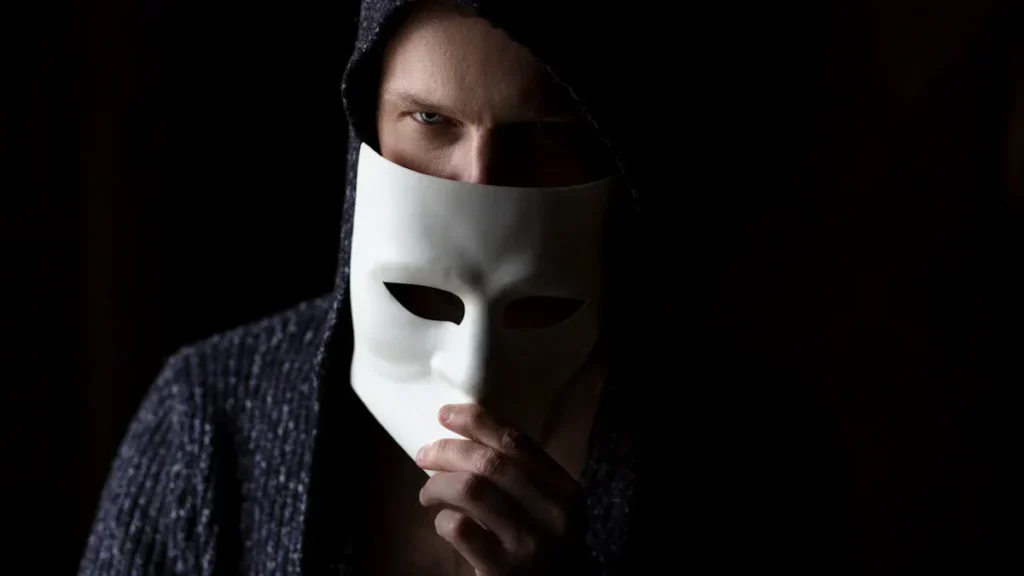
Do Covert Narcissists Know They Are Hiding Their Narcissism
This is the question every survivor needs answered. And the answer is maddening, because it’s both yes and no.
A 2025 article in Psychology Today examining self-awareness in covert narcissism makes a distinction you’ll recognize in your gut: covert narcissists often demonstrate recognition without responsibility. They can describe narcissistic traits with accuracy. Some will even say, “I know I have issues.” But that recognition never translates into changed behavior. Awareness exists. Accountability does not.
Dr. Susan Albers of the Cleveland Clinic has noted that covert narcissists often do not believe they are doing anything wrong, even when presented with evidence of the harm caused. The persona management is so embedded in their self-esteem regulation that the switching feels as natural as breathing to them.
And this is what makes it so destabilizing for survivors: the covert narcissist is aware enough to execute a clean persona switch based on who is watching, but claims enough ignorance to deny the switch happened. Their behavior is tactical. Their lack of accountability is strategic. That gap between what they do and what they admit keeps you in a loop of self-doubt that can last years.
“I know I’m not perfect, but you make it sound like I’m some kind of monster.” “I’ve read about narcissism. That’s not me.” These phrases are not accidents. They are the false self doing maintenance. They signal: I know enough about this topic to reference it, and I will use that knowledge to dismiss your perception rather than examine my behavior.
In my work with survivors, this is the piece that takes the longest to accept. I’ll be honest: it took me years in this field before I stopped looking for a clean answer to the awareness question myself. That the switching is deliberate enough to be intentional, but automatic enough to feel instinctive to the person doing it. Both things are true at the same time. And that’s what makes covert narcissism so difficult to name, prove, or explain to someone who has only ever seen the public mask.
The confusion you’ve been living with is not a sign that something is wrong with your perception. It is the direct result of a shame-driven system designed to operate without witnesses. The covert narcissist knows when to hide because their entire psychological wiring depends on never being fully seen. The switch is real. The pattern is documented. And the years you spent wondering if you were imagining it were never wasted. They were the cost of surviving something that was built to be invisible.
You don’t have to figure this out alone.
Work with Mr. Som Dutt — a coach who understands narcissistic dynamics inside out.
Whether you’re a survivor or recognizing narcissistic patterns in yourself — I help you see the cycles clearly and move forward.
For Survivors
Partners, spouses, parent/child, siblings, friends & colleagues — see the patterns, reclaim clarity.For Narcissists Seeking Change
Awareness is the hardest step. I help you understand and manage your behaviour.FAQs
How Do Covert Narcissists Know When To Hide Their Narcissism Around Certain People?
They run a constant threat detection loop rooted in shame avoidance, not social skill. Anyone who could expose them or withdraw narcissistic supply triggers an instant persona shift behind false humility.
Do Covert Narcissists Hide Their Narcissism On Purpose?
Research by Hart and colleagues shows covert narcissists use both assertive and defensive self-presentation tactics at the same time. The hiding is strategic enough to be audience-dependent, but shame makes genuine self-reflection close to impossible for them.
Why Do Covert Narcissists Act Differently When Hiding Their Narcissism In Public Vs Private?
The public persona protects their narcissistic supply pipeline. No witnesses means no social consequence, so private behavior reflects the real pattern behind the mask. I’ve worked with over 1,400 survivors who describe this public-private split as the single most disorienting part of covert narcissistic abuse.
Can Covert Narcissists Control When They Hide Their Narcissism?
A 2026 systematic review documents “audience-sensitive impression management” and “contextual fluency” in narcissistic traits. Covert narcissists adjust behavior based on who is present, and the switching is controlled enough to qualify as tactical self-presentation.
How Do Covert Narcissists Hide Their Narcissism From Friends And Family?
They rely on defensive self-presentation tactics like victim playing, performative empathy, and manufactured concern. Friends and family only see the public mask because covert narcissists reserve private cruelty for targets who lack the outside credibility to expose them.
What Triggers A Covert Narcissist To Stop Hiding Their Narcissism?
Supply depletion, ego threat overload, and narcissistic collapse cause the mask to crack. PMC research on momentary narcissistic states shows that vulnerability spikes produce increased interpersonal coldness rather than the warmth or sadness outsiders expect.
How Long Can Covert Narcissists Hide Their Narcissism In A Relationship?
Clinical literature documents a 7 to 10 year average recognition delay for victims of covert narcissistic abuse patterns. The mask holds longest in relationships where the victim’s empathy and loyalty provide a steady, unquestioned source of supply.
Do Covert Narcissists Know They Are Narcissists When They Hide Their Behavior?
Many covert narcissists can discuss narcissism with accuracy and even reference it in conversation. A 2025 Psychology Today analysis calls this “recognition without responsibility.” Awareness exists, but shame blocks the accountability needed for behavioral change.
Why Is It So Hard To Prove A Covert Narcissist Is Hiding Their Narcissism?
Plausible deniability is built into every covert narcissistic tactic. Phrases like “I was just joking” and “You misunderstood” create escape routes that make the abuse unprovable by design. The covert narcissist’s survival depends on no one being able to name what they do.
How Do Covert Narcissists Hide Their Narcissism At Work?
They use the same audience-dependent switching documented in all relationship contexts. Workplace covert narcissists present as team players or humble contributors while reserving passive-aggression, withholding, and quiet sabotage for targets behind closed doors where no one else is watching.
Last Updated on 15 April 2026 by Som Dutt